Follow the trail
30 min read
Chapter One
The Bible doesn't begin with theology. It begins with geography.
Genesis 2 places the Garden of Eden at the meeting point of four rivers: the Tigris, the Euphrates, the Pishon, and the Gihon. Two of these rivers still flow today through modern Iraq. The land between them is called Mesopotamia, Greek for "between the rivers", and every secular historian on earth agrees: this is where human civilization began.
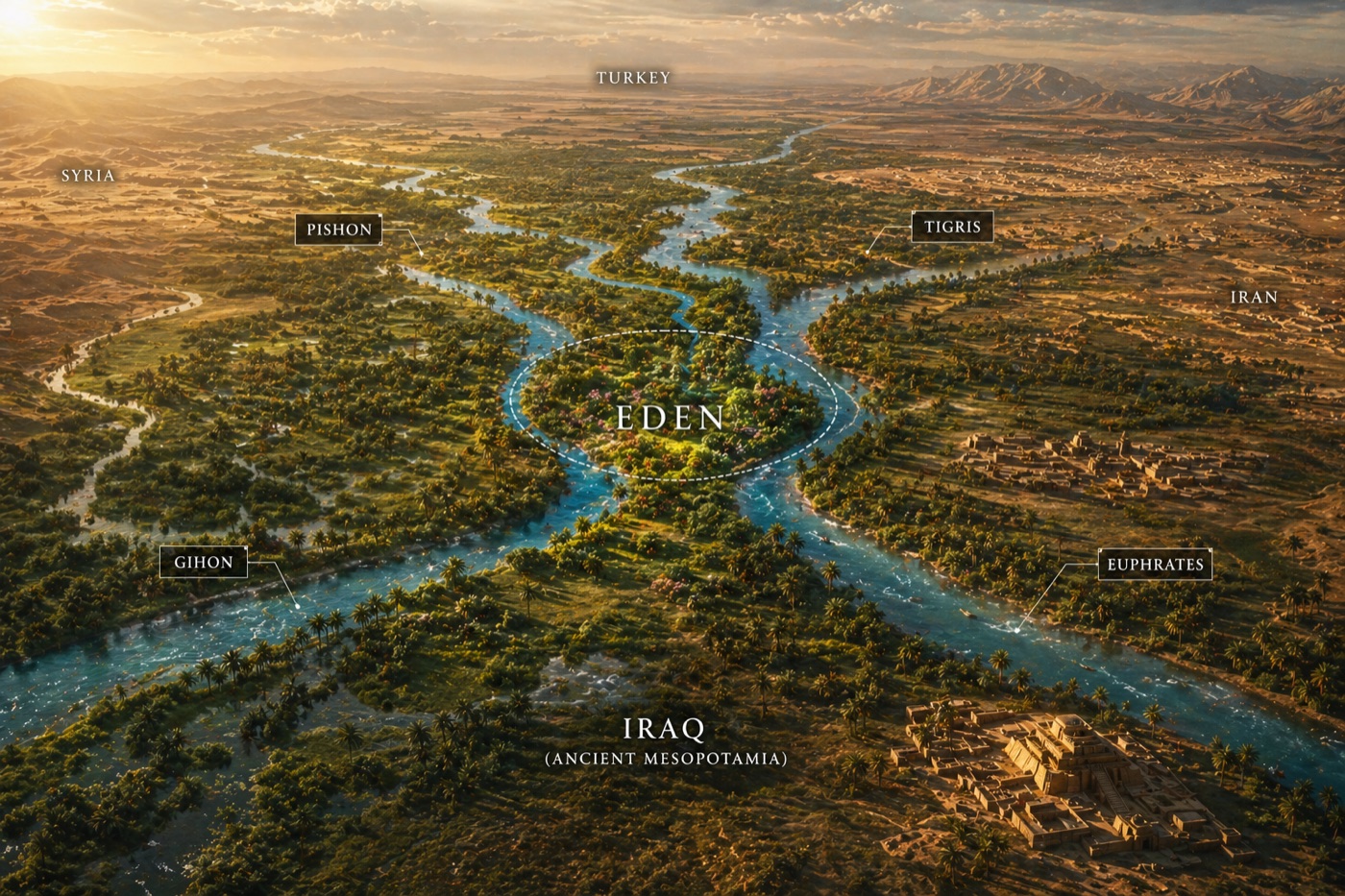
This is not a coincidence that requires faith to accept. It is a geographic convergence that demands an explanation from everyone, believer and skeptic alike. The oldest book in the Western canon and the entire field of modern archaeology point to the same patch of earth.
Archaeological Record
The Sumerian civilization, the oldest known to archaeology, emerged in southern Mesopotamia around 4500 BCE. Their cities (Ur, Uruk, Eridu) sit in the same river basin Genesis describes. The Sumerian King List, one of the oldest historical documents ever found, records kings who ruled "before the flood" with impossibly long reigns, then dramatically shorter reigns after it. The Bible records the same pattern: lifespans of 900+ years before Noah, rapidly declining afterward.
But Genesis doesn't describe cave-dwellers in this garden. It describes a world that already knows things. Adam names animals, an act of taxonomy and language. By Genesis 4, Cain builds a city. His descendant Jubal invents musical instruments. Tubal-Cain forges tools in bronze and iron. Within a few generations of Eden, humanity possesses metallurgy, music, architecture, and agriculture.
The conventional story says civilization slowly evolved from primitive beginnings. Genesis says it started advanced and then, after catastrophe, had to be rebuilt from memory. These are two fundamentally different claims about human history. The archaeological evidence, as we're about to see, has trouble with the conventional version.
Chapter Two
If civilization progressed gradually from simple to complex, the oldest structures on earth should be the crudest. They are not. The oldest structures on earth are among the most mysterious and technically astonishing things humanity has ever produced.
Three sites, separated by thousands of kilometers and thousands of years, anchor this chapter. Each one breaks the timeline in its own way, and together they tell a single story: the deeper you dig, the more sophisticated the builders become.
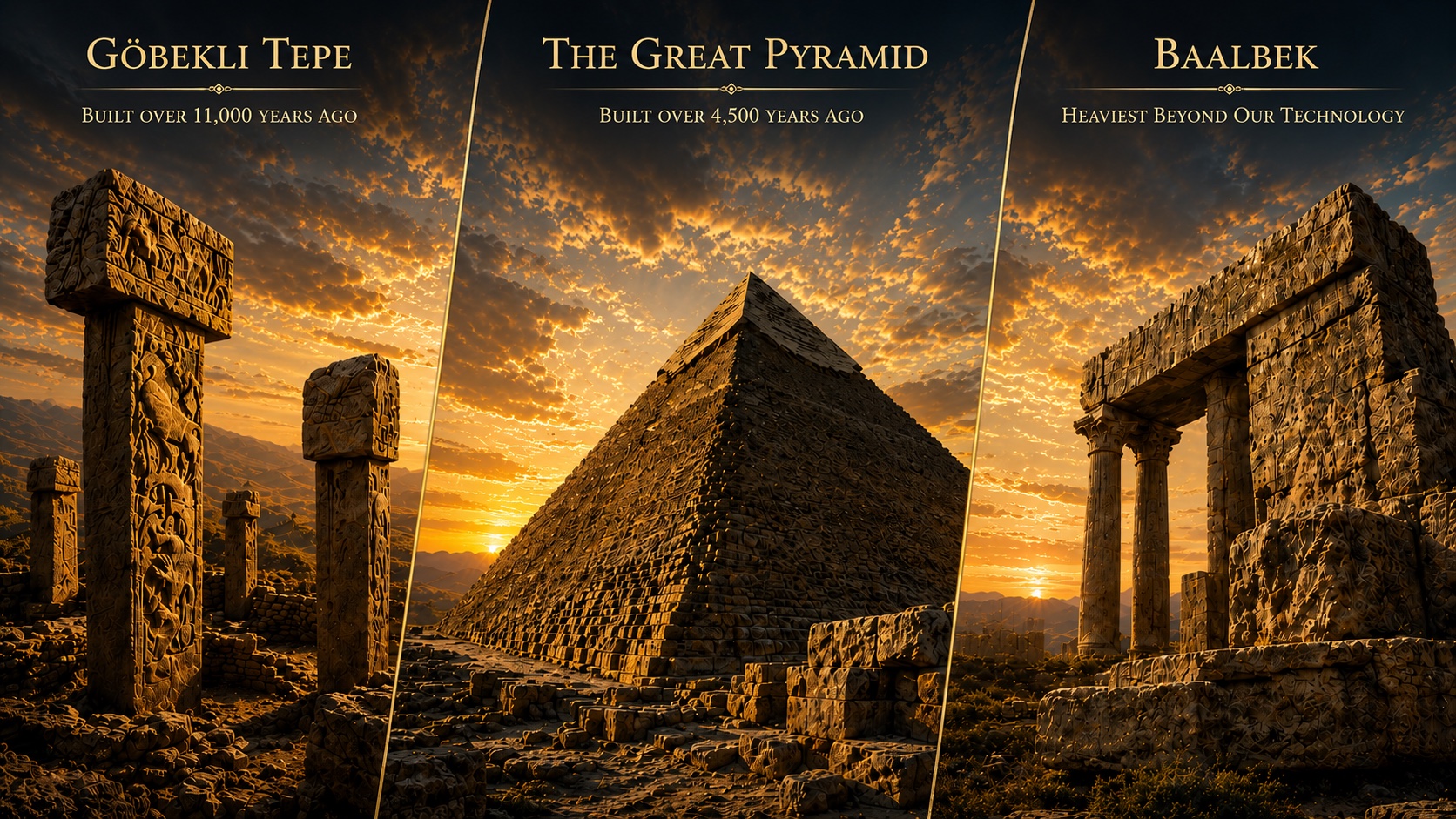
Discovered in 1994, Göbekli Tepe is conventionally dated to approximately 9500 BCE, over 6,000 years before Stonehenge and 7,000 years before the Great Pyramid. According to mainstream archaeology, humans at this time were hunter-gatherers who had not yet invented farming, pottery, or metal tools.
And yet someone built this.
The site contains massive T-shaped limestone pillars, some standing 5.5 meters tall and weighing up to 10 tons. They are arranged in sophisticated circular enclosures, carved with detailed animal reliefs, lions, bulls, serpents, vultures, scorpions, executed with artistic precision. The pillars show astronomical alignments. The engineering required quarrying, transporting, carving, and erecting multi-ton megaliths with coordinated labor on a monumental scale.
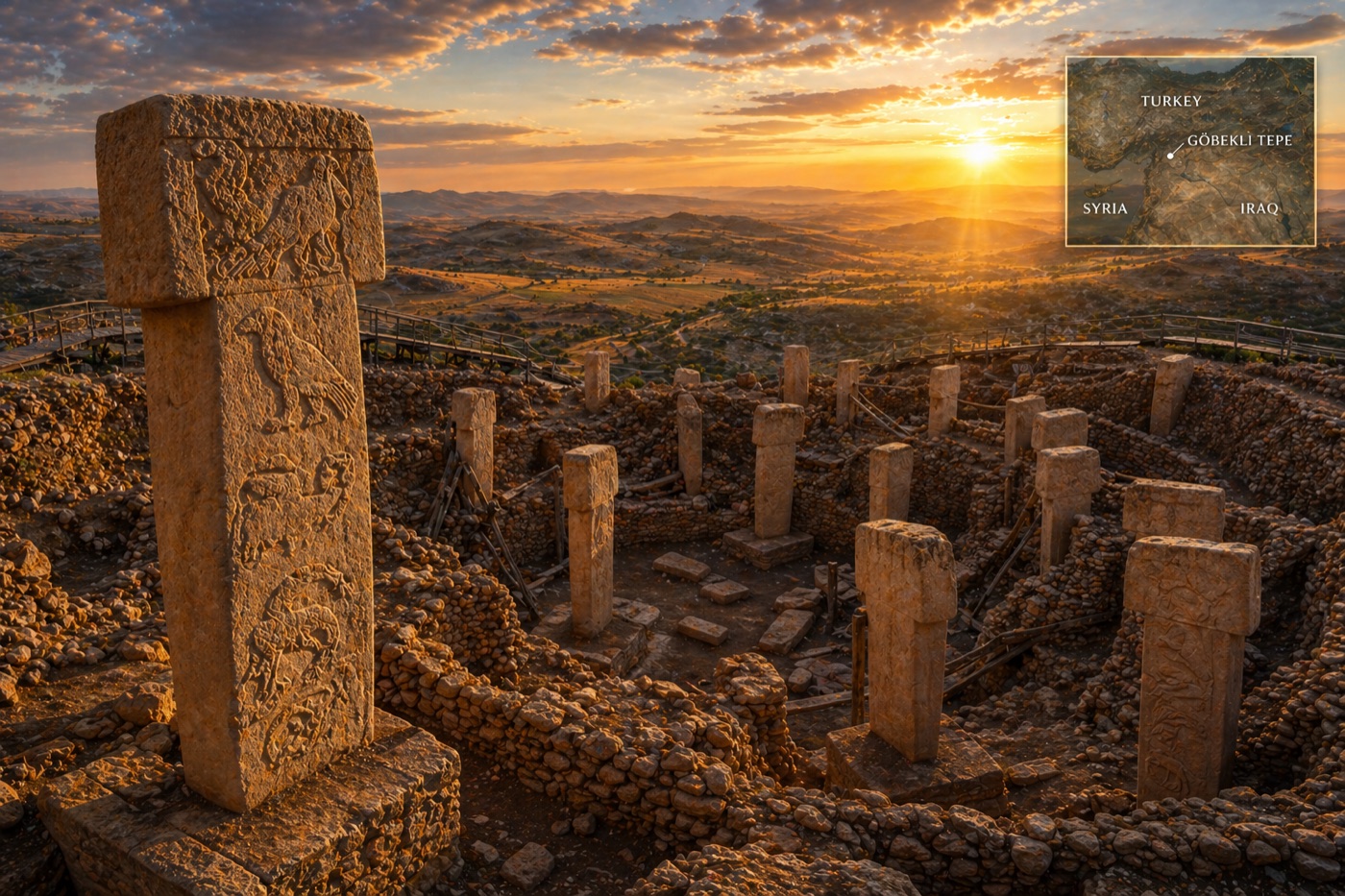
This is not what hunter-gatherers are supposed to be capable of.
But the deeper mystery is what happened to it. The site was buried.
The Burial of Göbekli Tepe
The original excavators believed the monuments were intentionally backfilled with debris, limestone rubble, flint tools, animal bones, brought from elsewhere. Recent studies suggest the burial process was complex: partly intentional, partly caused by slope-slide events and structural collapse. What is clear is that the site was covered and abandoned, its massive pillars sealed under earth. The structures served their community for roughly a millennium before being entombed. Sediment doesn't naturally collect on hilltops, making deliberate burial the most discussed explanation. Why would anyone bury something that took generations to build?
The Bible offers a framework: God repeatedly commands the destruction of pagan high places and false worship sites throughout the Old Testament. If Göbekli Tepe was an early post-Eden worship site that had turned to false gods, as the carved animal imagery and possible cultic skull rituals suggest, its intentional burial fits a pattern the Bible documents extensively.
The Great Pyramid contains approximately 2.3 million stone blocks, each weighing 2 to 80 tons. It stood as the tallest structure on earth for 3,800 years. Its engineering tolerances remain stunning by modern standards:
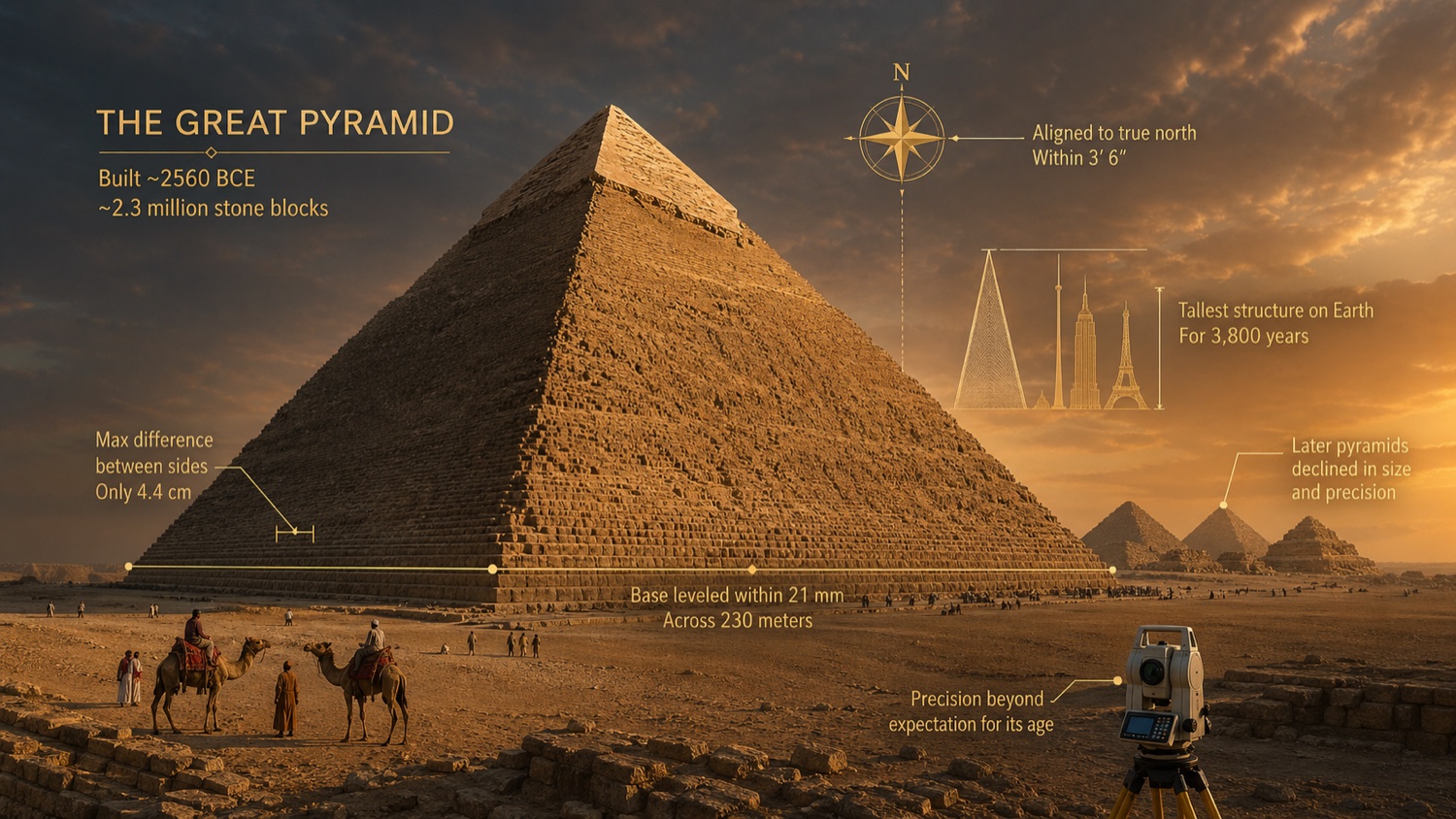
The base is leveled to within 21 millimeters across 230 meters, a precision that NASA's own north-south margins would accept. Its sides are aligned to the cardinal directions with an accuracy of better than one-fifteenth of a degree. No engineering documents, architectural plans, or sophisticated survey equipment from this era have ever been found. No one knows exactly how they achieved this.
Here is the problem for the conventional timeline: the later pyramids are worse. The 5th and 6th Dynasty pyramids, built centuries after the Great Pyramid, are smaller, less precise, and many are crumbling. If civilization was progressing, the engineering should have improved. Instead, it declined. What we observe is not a learning curve going up, it's inherited knowledge running out.
The numbers above are impressive. What follows is why they remain unexplained.
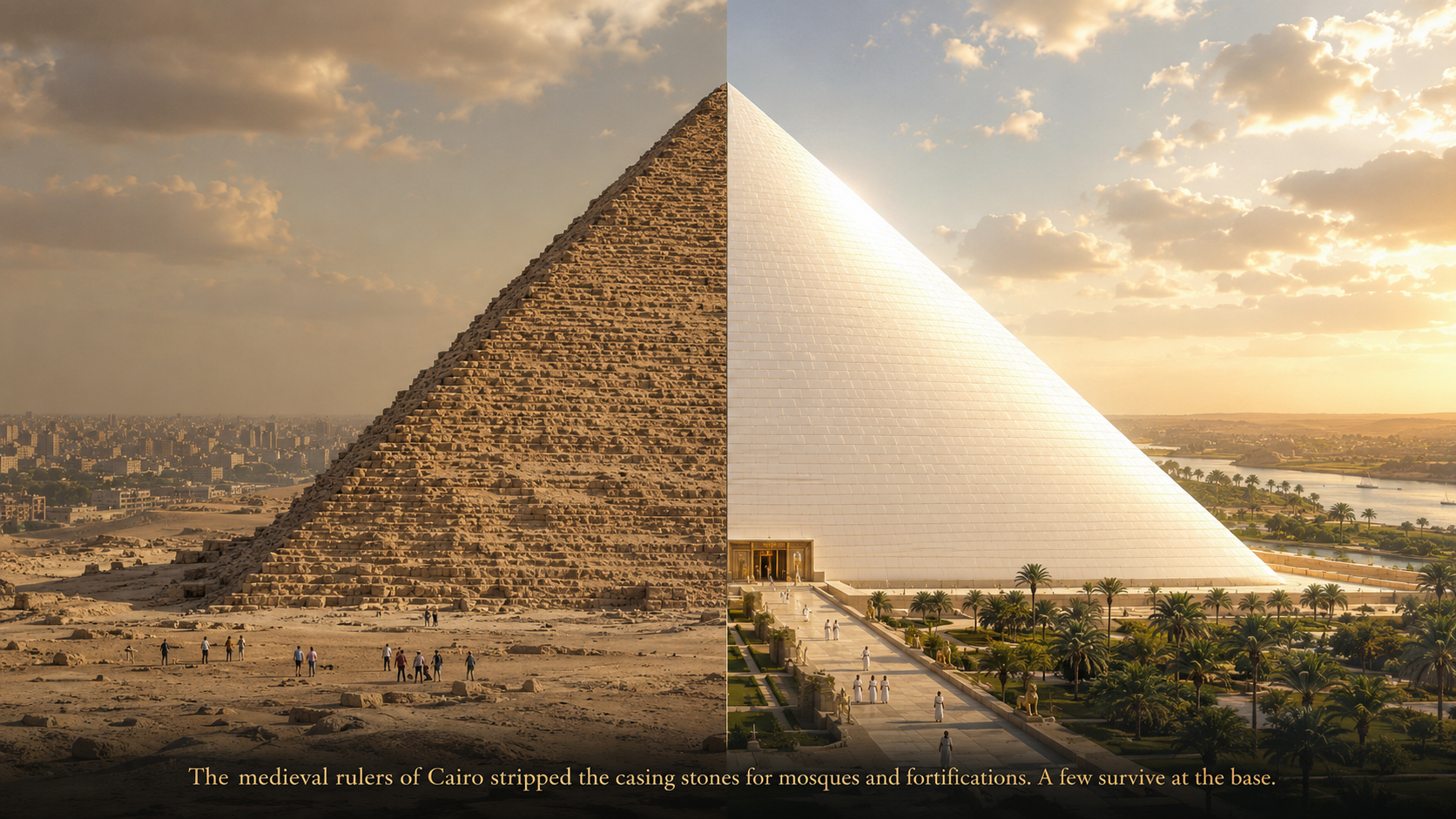
What stands at Giza today is a skeleton. The Great Pyramid was originally sheathed in 144,000 polished Tura limestone casing stones — each cut to optical flatness and fitted so precisely that a knife blade could not be inserted between them. The surface was a seamless, gleaming white that reflected sunlight so intensely it was reportedly visible from the mountains of Israel. The medieval rulers of Cairo stripped the casing in the 13th and 14th centuries to build mosques and fortifications. A few original stones survive at the base. What tourists photograph today is the rough inner core — the scaffolding, not the building.
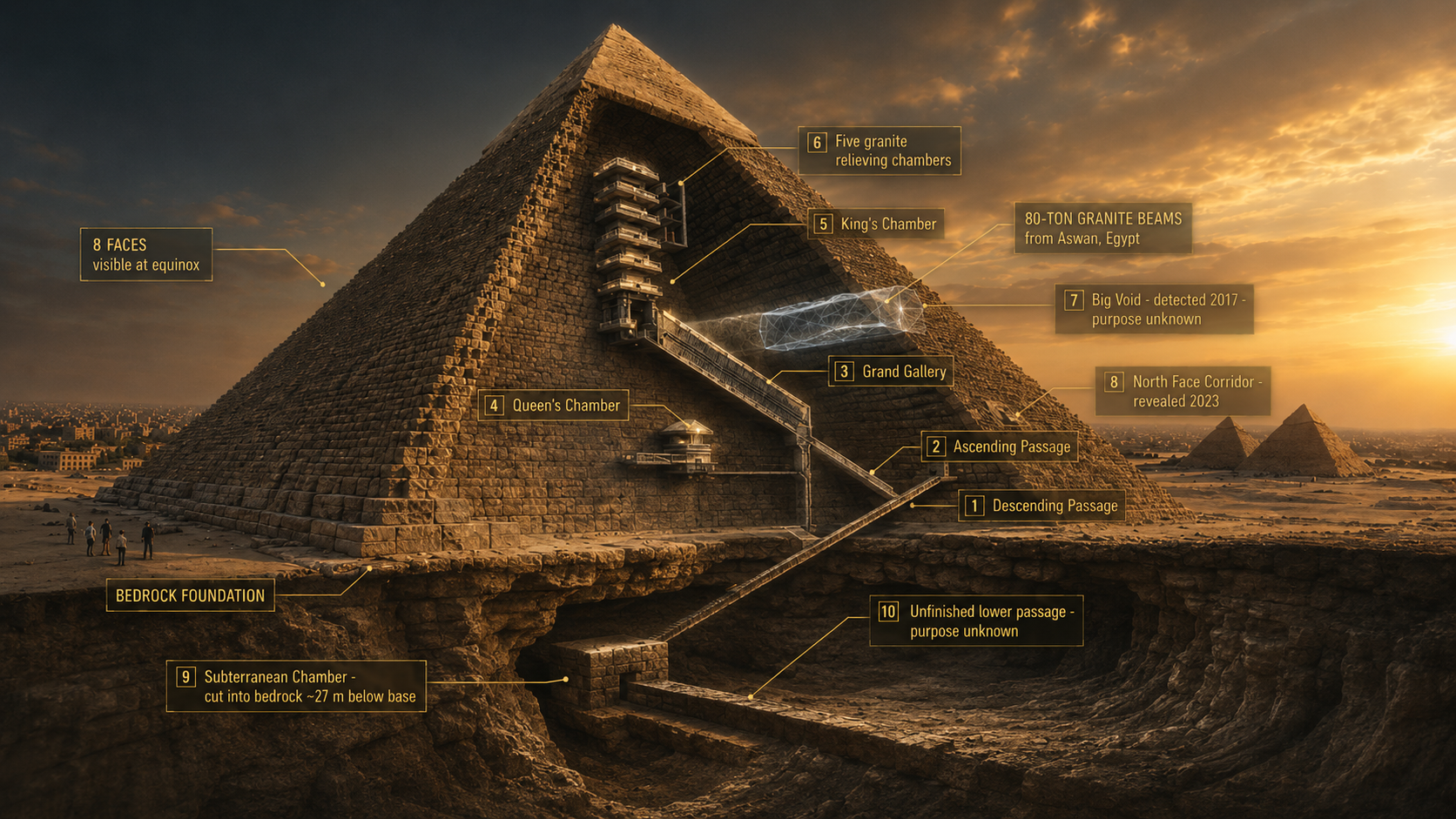
To stack 2.3 million blocks into a 146-meter pyramid, you need a way to get them up. Quarrying and Nile delivery are broadly understood — the debate is how the stones went up. Four mainstream theories have been proposed over the past two centuries. Each one solves a problem the previous one created, and each one introduces a new problem it cannot solve.
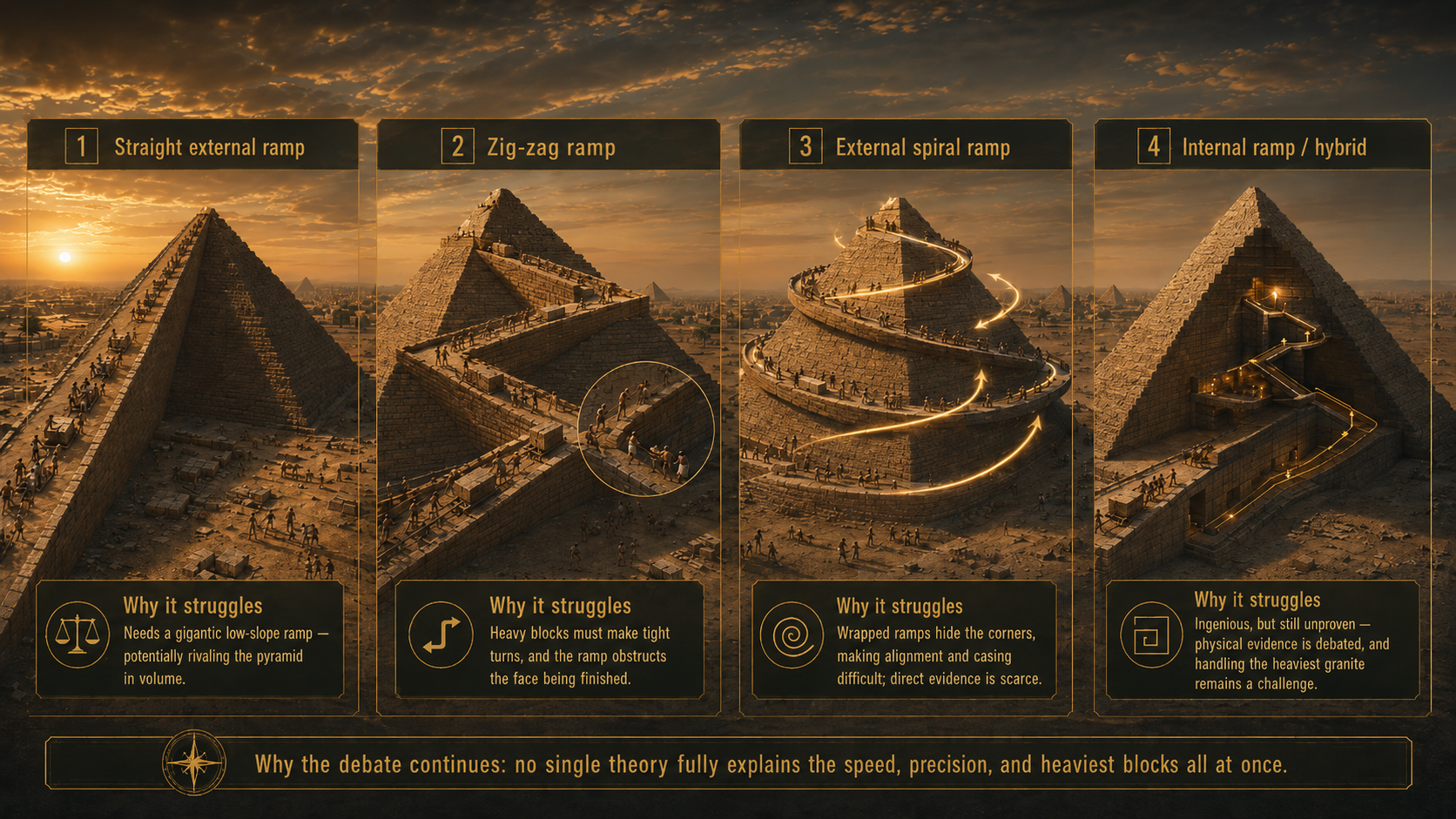
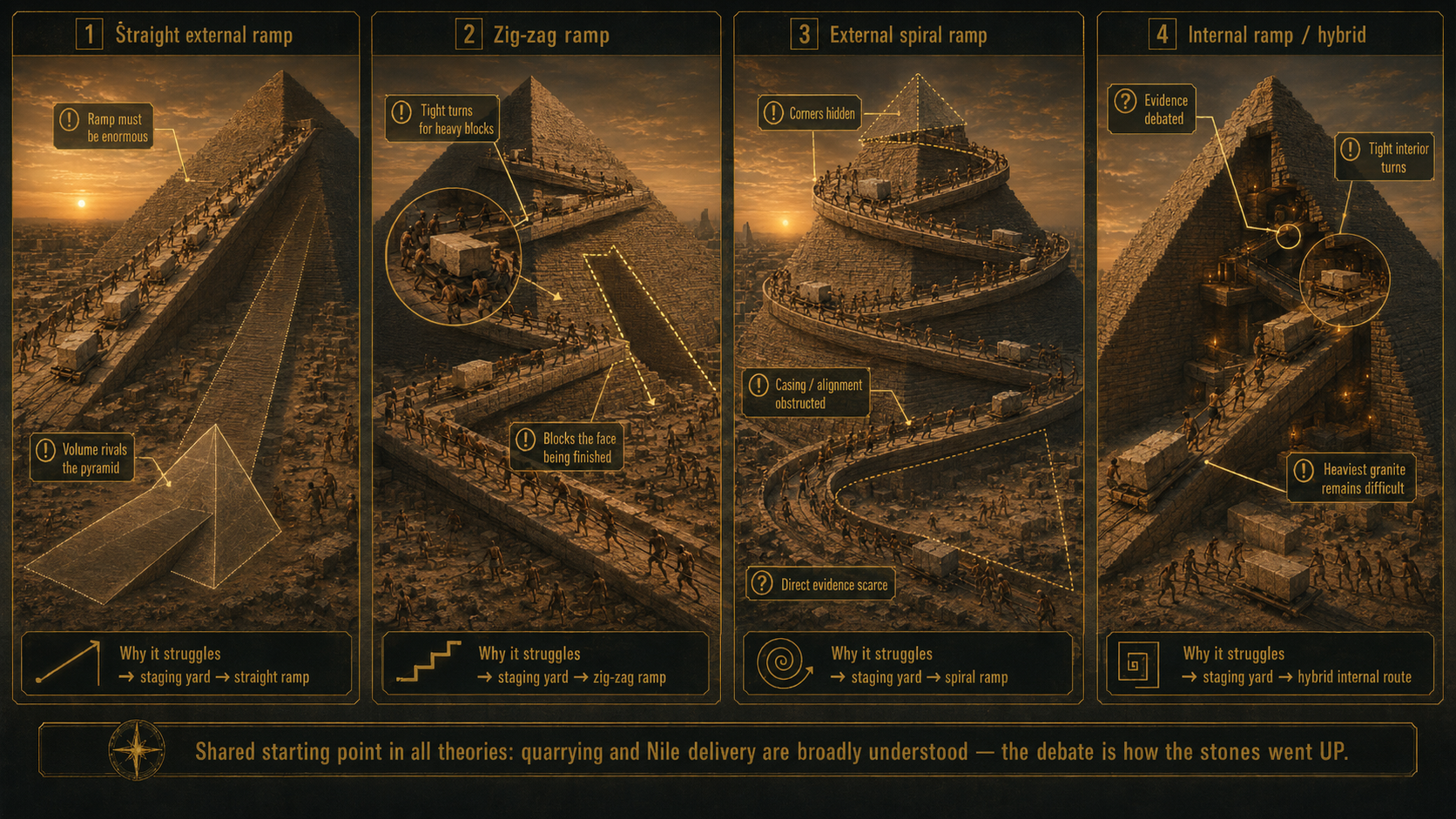
Straight external ramp: At a 10% gradient — the steepest angle workers can drag multi-ton loads — the ramp would need to extend 1.5 kilometers to reach the summit. Its volume would be roughly three times the pyramid itself. No trace has been found at Giza.
Zig-zag ramp: Solves the length problem by switching back on the pyramid's face. But multi-ton blocks cannot make tight turns, the ramp obstructs the face being finished, and it still requires enormous material.
External spiral ramp: Wraps around the pyramid, eliminating both length and switchback problems. But it hides the corners — making precision alignment and casing impossible to verify during construction. No direct archaeological evidence has been found.
Internal ramp (Houdin, 2025): The most recent and ingenious proposal — ramps hidden inside the pyramid itself, supported by thermal anomalies detected by the ScanPyramids project. But the physical evidence is debated, interior turns are tight, and it still cannot explain how the heaviest granite beams (up to 80 tons) were maneuvered through narrow internal passages.
No single theory explains the speed, the precision, and the heaviest blocks all at once. The debate continues because the evidence for every proposal is either absent, insufficient, or contradicted by the engineering requirements.
And then there is the timeline. 2.3 million blocks in 20 years, working ten-hour days, 365 days a year. That is one block quarried, transported, lifted, and placed with millimeter precision every 2 minutes and 12 seconds, for two decades straight. A 2026 computational study in Nature found this rate theoretically achievable — in a model. No physical experiment has come close.
The Pipeline Problem
Modern construction projects with mechanized equipment — hydraulic cranes, diesel trucks, GPS surveying — rarely sustain a throughput rate equivalent to what the Great Pyramid demanded. The builders did it with copper chisels, dolerite hammers, wooden sledges, and rope. No iron. No wheels. No pulleys that we know of. Every block in that pipeline was the weight of a city bus.
Between the pyramid's blocks sits approximately 500,000 tons of gypsum-based mortar. Its chemical composition has been analyzed: gypsum microcrystals with sand, crushed limestone, and traces of organic matter. A 1988 study in Cement and Concrete Research found something remarkable — the mortar is still chemically active, still undergoing a slow anhydrite-gypsum transformation after 4,500 years.
It is stronger than the stone it bonds. Modern reinforced concrete is rated for 50 to 100 years before it requires structural intervention.
Despite knowing its exact chemical composition, no modern laboratory has successfully replicated it. We know what it is. We do not know how to make it.
In 2017, the ScanPyramids project fired muons through the pyramid's mass and detected a void above the Grand Gallery — at least 30 meters long, the largest internal structure discovered since the 19th century. It has never been physically accessed. No one knows what it contains or why it exists.
In 2023, a second discovery: a previously unknown corridor on the north face, approximately 9 meters long and 2 meters wide. Egyptologist Zahi Hawass stated: "I believe that something very important is hidden under this corridor." Further investigation is scheduled for 2026-2027.
4,500 years after construction, we are still finding rooms inside a structure that supposedly required no writing system, no architectural blueprints, and no survey instruments to build.
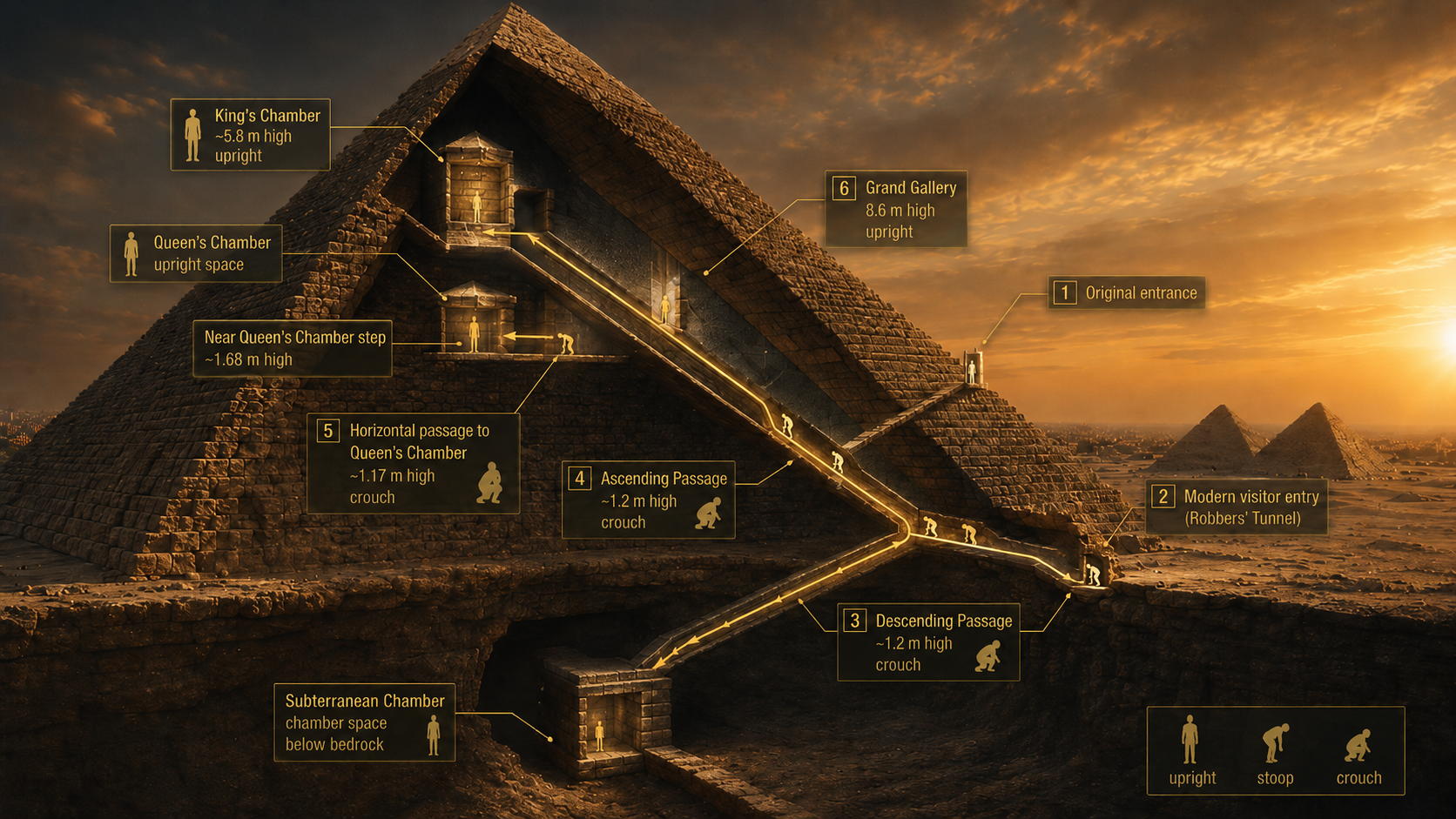
The passages that connect these chambers tell their own story. The ascending and descending corridors are just 1.2 meters high — barely enough to crouch through. The horizontal passage to the Queen's Chamber drops to 1.17 meters. Then, without warning, the Grand Gallery opens to 8.6 meters — a soaring corbelled vault that runs 47 meters upward at a 26-degree incline. The shift from crawlspace to cathedral is abrupt and deliberate. Why build passages too small for a person to stand in, then connect them to a gallery tall enough to hold a three-story building?
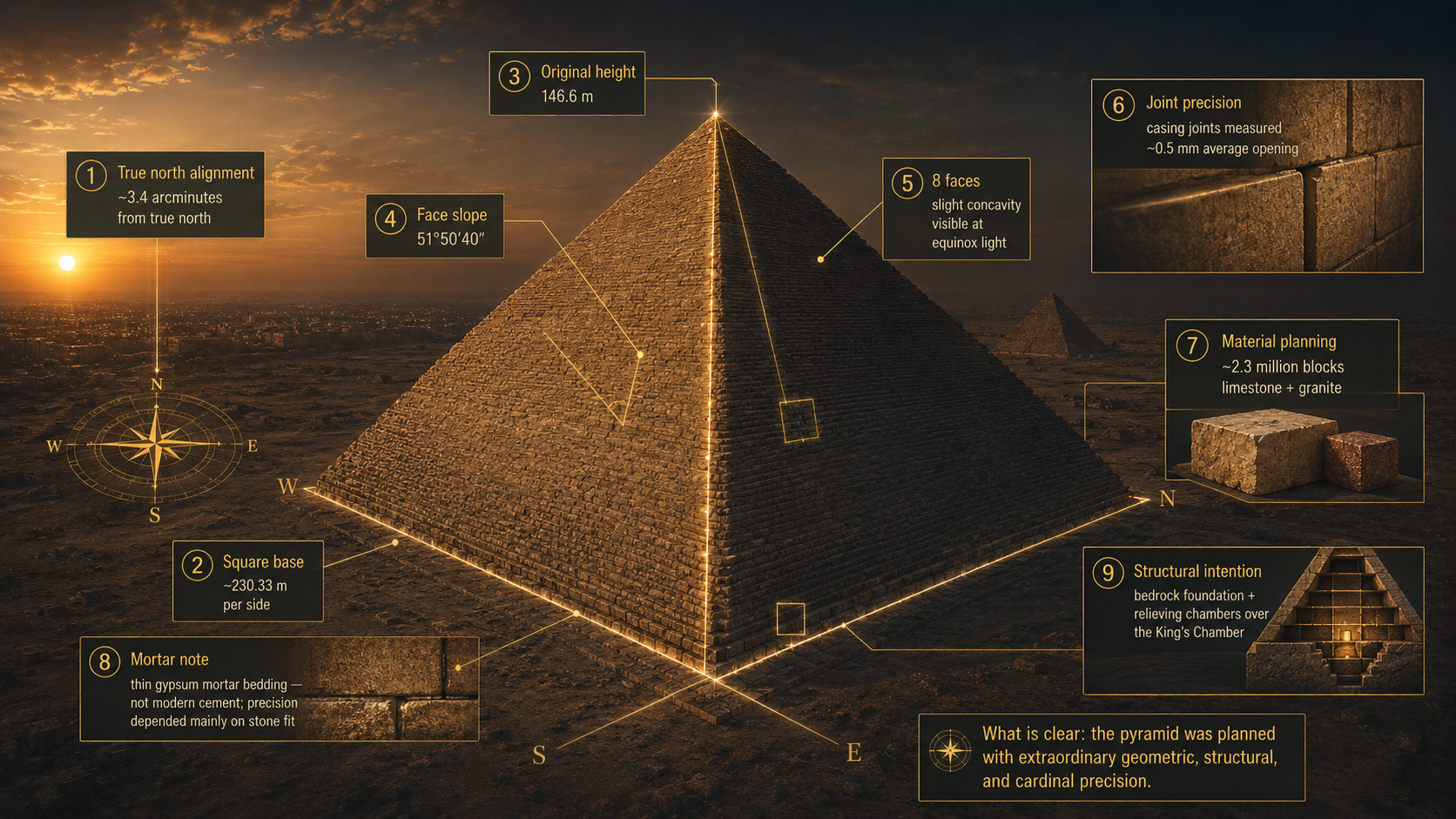
The precision of the Great Pyramid is not a single impressive statistic. It is a pattern of precision across every measurable dimension, each one reinforcing the others.
The base is aligned to true north within 3.4 arcminutes — a sixteenth of a degree. Achieving this today requires a precision theodolite. The four sides, each 230.33 meters long, differ from one another by a maximum of 58 millimeters. The casing stones were fitted with joints averaging 0.5 millimeters — thinner than a credit card. The mortar between them was not structural cement; it was thin gypsum bedding, meaning the precision depended almost entirely on the cut of the stone itself.
The face slope of 51°50'40" produces a geometry where the perimeter divided by the height equals 2π to three decimal places — and where the slant height divided by the half-base equals φ (the golden ratio) to three decimal places. Whether intentional or an emergent property of the Egyptian seked slope system, the mathematical relationships are real and measured.
And then there are the eight faces. In 1940, a British pilot photographed the pyramid at sunset during the equinox and noticed something invisible from the ground: each face has a subtle concavity running down its centre, making the pyramid an eight-sided structure. LiDAR scanning has confirmed this. A 2023 study attributed it to intentionally angled courses at approximately 11 degrees — structural reinforcement against gravity, earthquakes, and weathering. This feature is visible only twice a year, when the equinox sun casts shadows at precisely the right angle.
They engineered a structural feature invisible to the naked eye 363 days a year — 4,500 years before we had the instruments to detect it. These are not the tolerances of a civilization learning as it goes. These are the tolerances of a civilization that already knew.
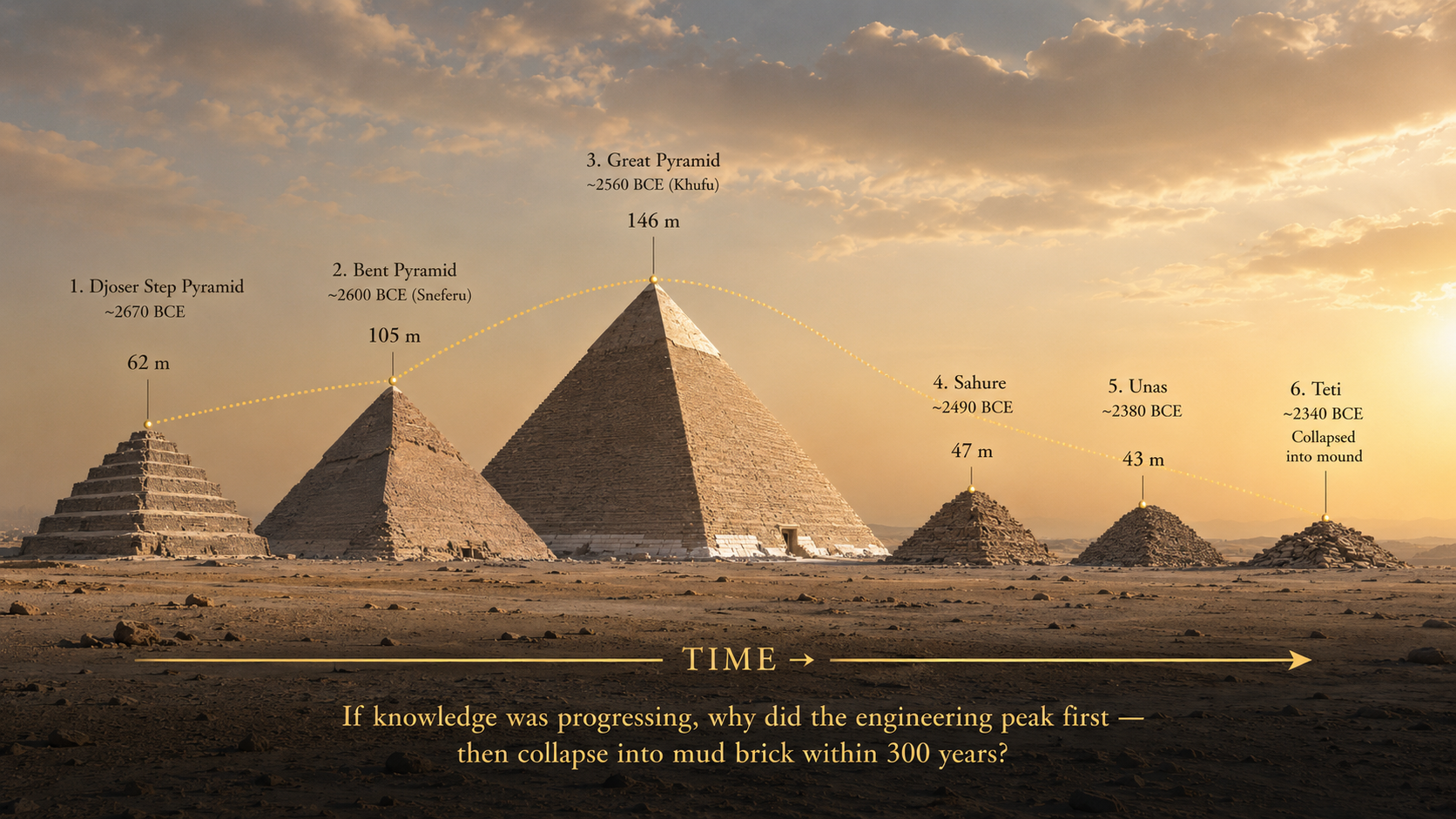
The standard model of civilization is accumulation — each generation builds on the last. But the pyramid record shows the opposite. The Great Pyramid at 2560 BCE represents the absolute peak: 146 meters, 2.3 million blocks, sub-millimeter precision. Within 300 years, the pyramids of Sahure and Unas had shrunk to a third the height and were built with rubble-fill cores. By the time of Teti, around 2340 BCE, the result had collapsed into an unrecognizable mound.
This is not a gradual decline. This is a cliff. The knowledge required to build the Great Pyramid did not slowly fade — it vanished, as if the generation that built it possessed something the next generation did not inherit. If the technique was learnable, it would have been learned. If the knowledge was institutional, it would have been preserved. The regression suggests that whatever enabled the Great Pyramid was not a tradition passed down through apprenticeship. It was something else — and when it was gone, it was gone completely.
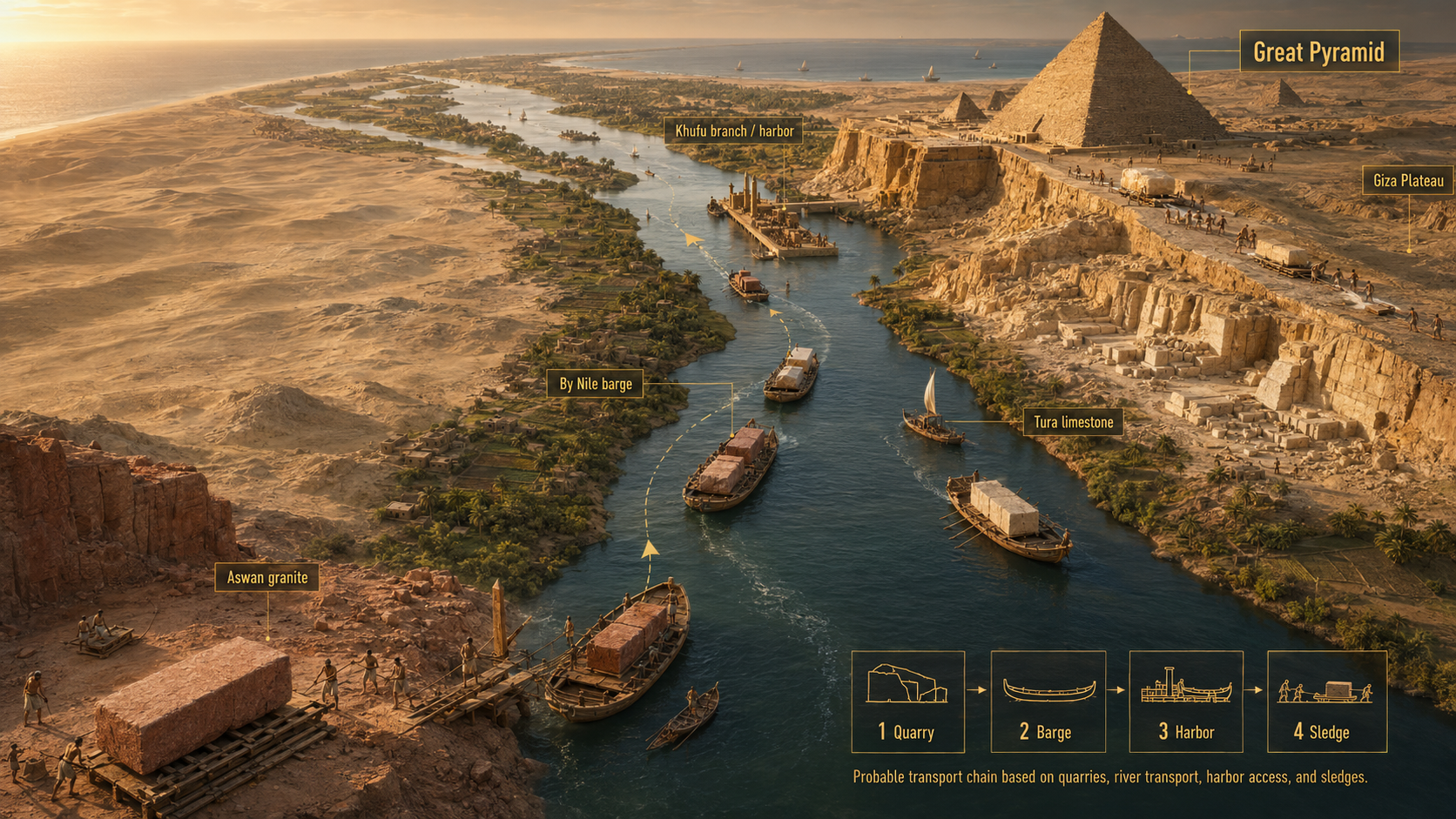
The heaviest granite beams in the King's Chamber weigh up to 80 tons. They were quarried at Aswan — 900 kilometers upriver — and transported on wooden barges with no iron fasteners down the Nile, navigating the First Cataract rapids where multi-ton blocks had to be unloaded, portaged overland around violent white water, and reloaded onto new vessels. The Diary of Merer — papyri discovered in 2013 at Wadi al-Jarf, the only first-person account of pyramid construction logistics ever found — documents limestone transport from Tura to Giza by boat crews during Khufu's 26th regnal year.
The transport chain was: quarry the block, drag it to the riverbank, load it onto a wooden barge, sail 900 kilometers, unload at the harbor, drag it overland on sledges to the plateau. For granite blocks weighing up to 80 tons. With no wheels, no iron tools, and wooden vessels with no keel.
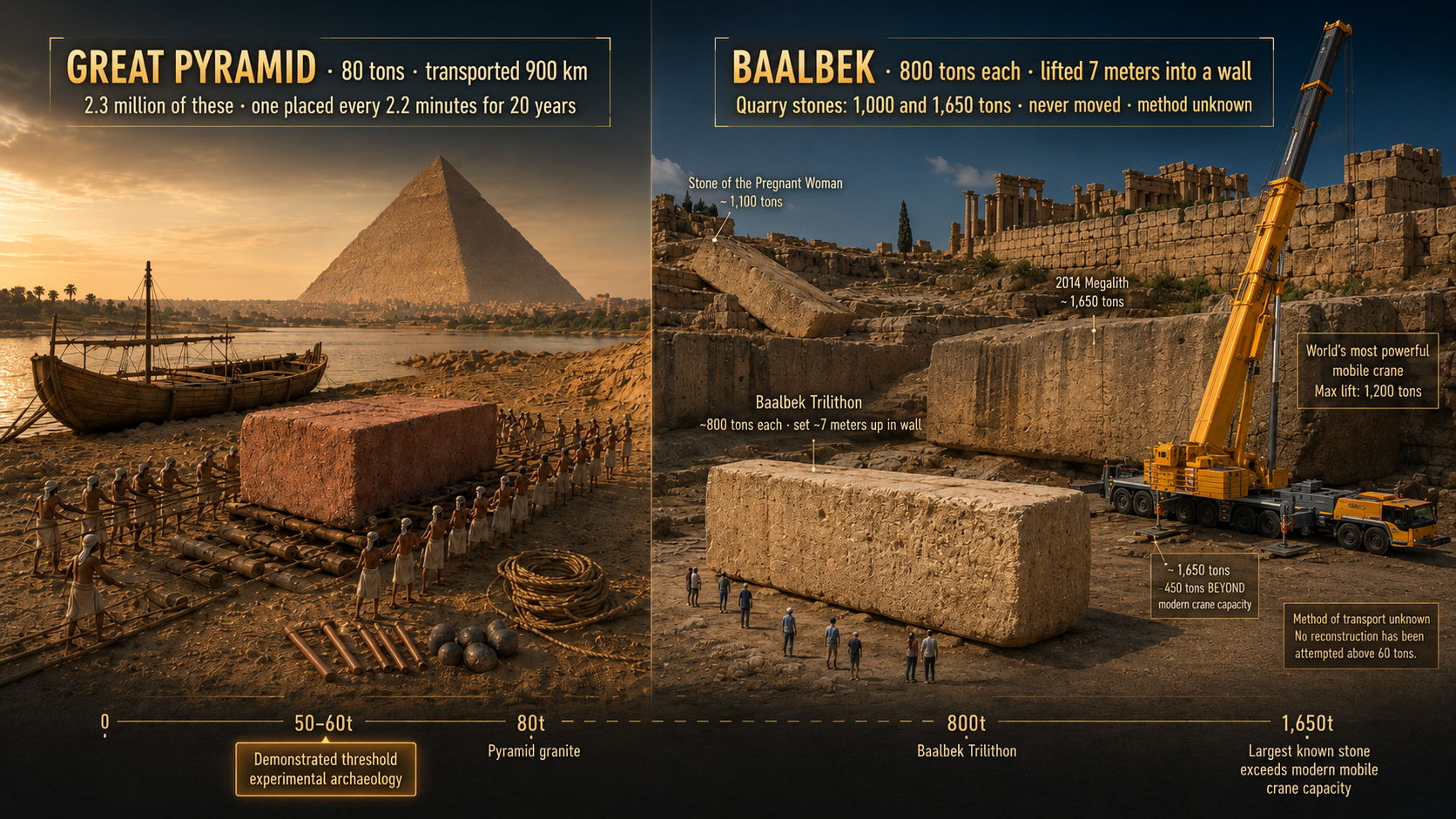
Experimental archaeology has successfully demonstrated these methods for loads up to approximately 50-60 tons. Above that threshold, no reconstruction has ever been attempted. The pyramid's granite sits 30% above this ceiling. That gap has never been bridged.
But the pyramid's transport challenge becomes a footnote when you look 2,400 kilometers northwest.
Baalbek, Lebanon: The Stones That Break Everything
Three stones known as the Trilithon sit in a foundation wall that predates Rome. Each weighs approximately 800 tons — ten times the pyramid's heaviest block. They were not only quarried and moved 800 meters, but lifted seven meters into the wall and fitted with sub-millimeter precision. A knife blade cannot pass between them. In the nearby quarry, two even larger stones remain: the Stone of the Pregnant Woman at roughly 1,000 tons, and a megalith discovered in 2014 weighing approximately 1,650 tons — the largest hewn stone in human history.
The most powerful lifting device in the ancient world was the Roman treadwheel crane, capable of raising approximately 6 to 7 tons. The Trilithon stones are 130 times heavier. And the Baalbek foundation predates Rome — meaning even that crane was not yet available when these stones were placed.
The most powerful mobile crane in the modern world — the Liebherr LTM 11200-9.1 — has a maximum lift capacity of 1,200 tons at minimum boom radius. The 1,650-ton quarry stone exceeds it by 450 tons.
No ancient method. No modern machine. The stones are in the wall.
The mainstream consensus holds that the Great Pyramid was a tomb for Pharaoh Khufu — and nothing more. No body has ever been found inside it. No burial goods, no inscriptions, no sarcophagus lid. The granite "sarcophagus" in the King's Chamber is an open, unmarked, lidless box that shows no evidence of ever having held a body. Every other royal tomb in Egypt is covered in hieroglyphs. The Great Pyramid's interior is entirely bare.
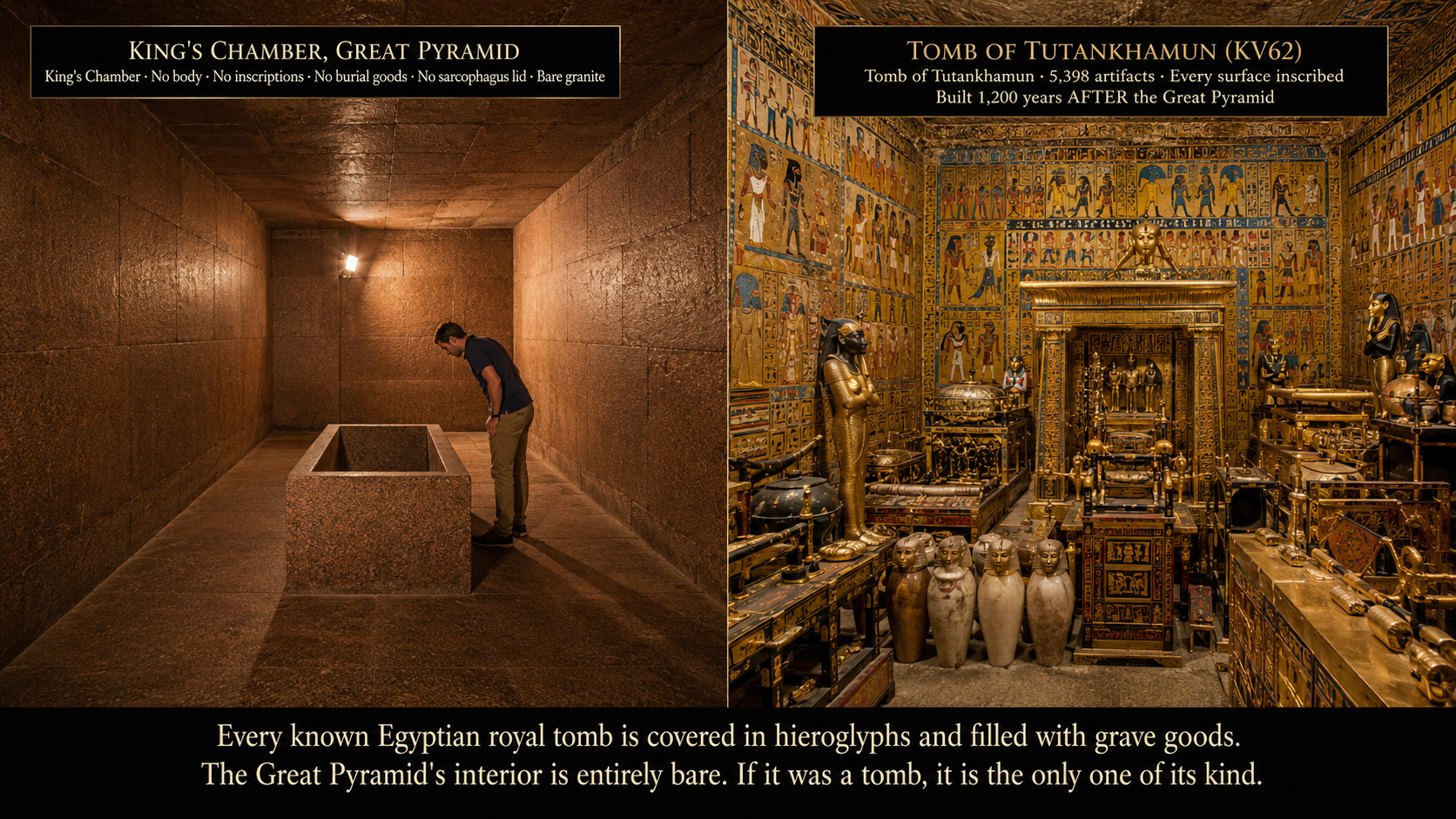
The contrast is not subtle. Tutankhamun's tomb — built 1,200 years after the Great Pyramid — contained 5,398 artefacts, every wall inscribed, every surface decorated. The Great Pyramid contains nothing. The standard explanation is that it was looted in antiquity. But tomb robbers take gold and jewellery — they do not chisel off every inscription, scrub every wall bare, and remove the sarcophagus lid. No other tomb in Egypt, looted or not, has been found in this condition.
In 2018, a peer-reviewed study in the Journal of Applied Physics by researchers at ITMO University and the Leibniz Universität Hannover found something unexpected. Using computational physics and multipole analysis, they demonstrated that the Great Pyramid can concentrate electromagnetic energy in its internal chambers and under its base when exposed to radio waves in the 200-600 meter range. The pyramid's geometry creates resonant conditions — its shape functions as an electromagnetic focusing structure.
This was not a fringe claim. It was published in a mainstream physics journal. The authors were studying nanoparticle design and used the pyramid's geometry as a model for how shapes concentrate energy at specific wavelengths.
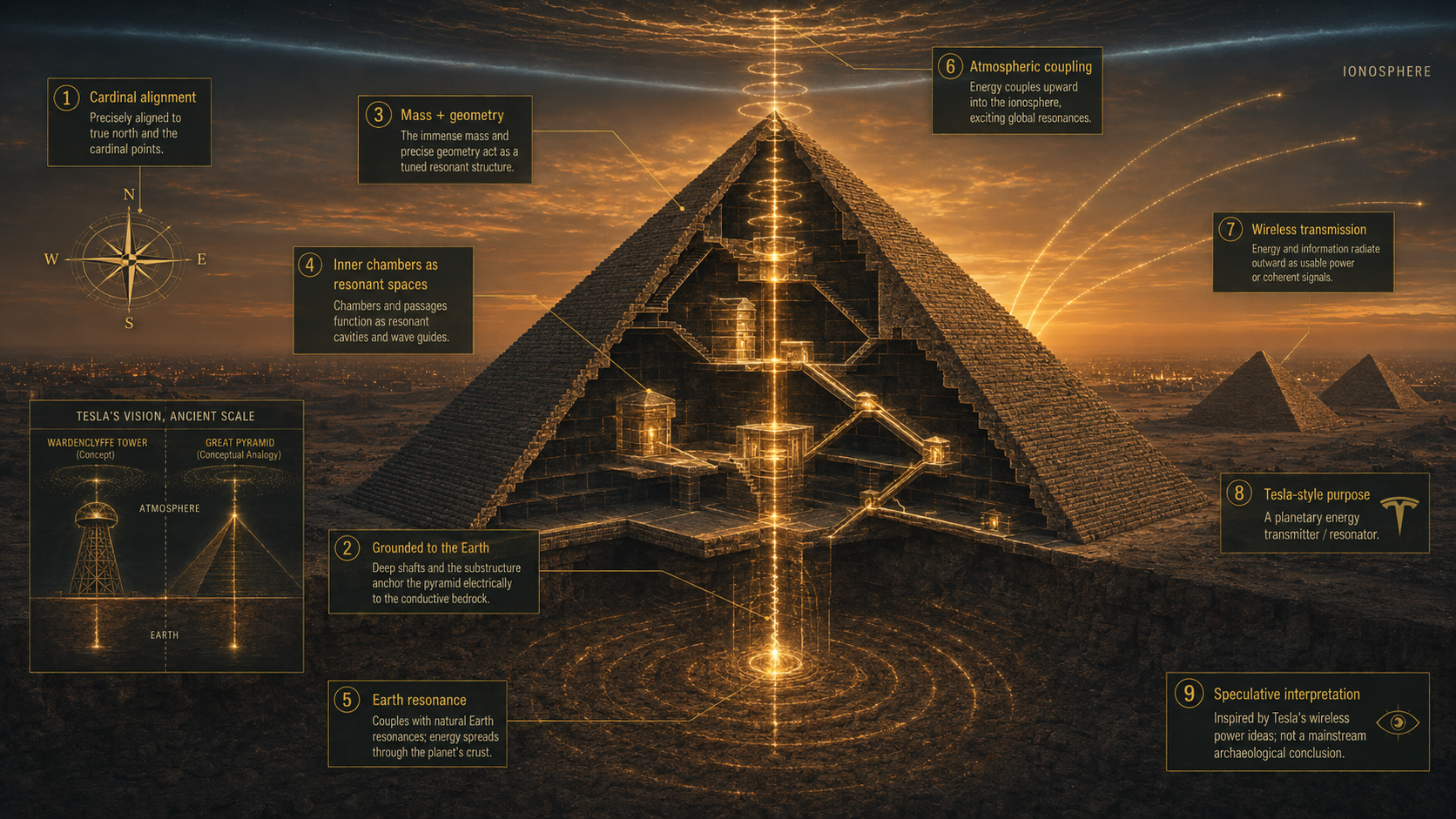
Nikola Tesla spent the last decades of his life pursuing wireless energy transmission. His Wardenclyffe Tower, begun in 1901 on Long Island, was designed to transmit power without wires by coupling energy between the Earth's conductive crust and the ionosphere. The tower was grounded deep into the bedrock, precisely shaped to resonate at specific frequencies, and intended to excite the Earth's natural electromagnetic cavity — the Schumann resonance at 7.83 Hz — to transmit energy globally.
Tesla was documented as being fascinated by the pyramids. He believed their placement was not arbitrary but chosen according to the relationship between the Earth's orbit and equator. He saw them, in his own words, as potential transmitters.
The structural parallels are observable, regardless of what one makes of them:
The Overlap
Both the Wardenclyffe Tower and the Great Pyramid are grounded to bedrock through deep substructures. Both employ precise geometry designed around resonant proportions. Both contain internal cavities whose dimensions correspond to specific wavelengths. The King's Chamber is built entirely from Aswan granite, which contains high concentrations of quartz — a piezoelectric crystal that generates electrical charge under mechanical stress. The pyramid sits atop the Giza aquifer, where underground water movement through limestone creates a natural source of electromagnetic activity. Tesla's tower was never completed. The pyramid has stood for 4,500 years.
None of this proves the pyramid was an energy device. But the 2018 study proves its geometry functions as one — whether that was intended or not. The question is whether a civilization that achieved 0.5mm joint precision, sub-arcminute cardinal alignment, and mathematical constants encoded to three decimal places would have built a structure with these electromagnetic properties by accident.
This is a speculative interpretation, not a mainstream archaeological conclusion. But it is grounded in published physics, documented history, and a question the tomb theory has never adequately answered: why build the most precisely engineered structure in human history — and leave it completely empty?
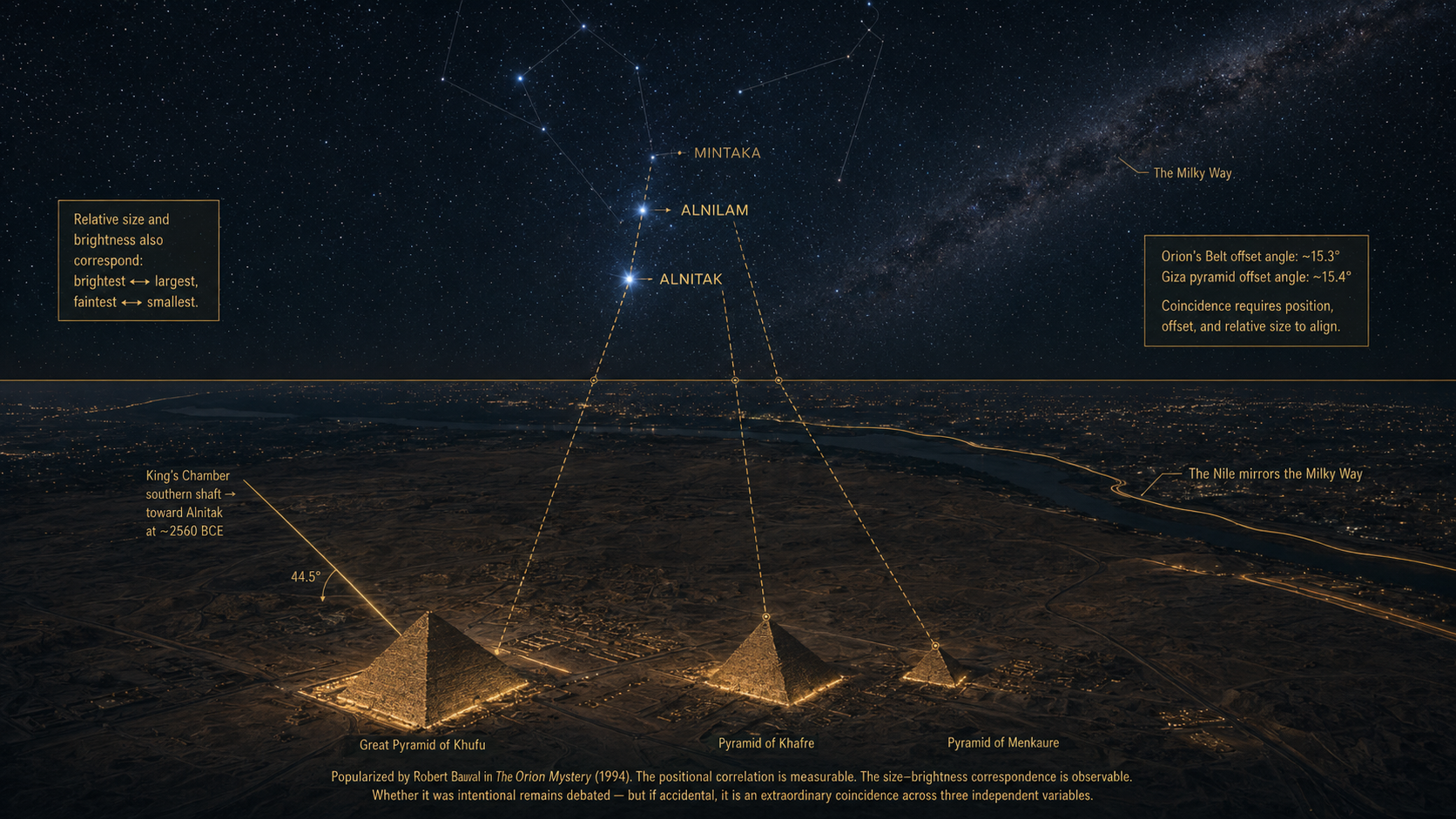
In 1994, Robert Bauval published The Orion Mystery, proposing that the three Giza pyramids were laid out to mirror Orion's Belt. The claim was controversial. The correlation, however, is measurable.
The three pyramids match the three belt stars — Alnitak, Alnilam, and Mintaka — in relative position, relative size, and angular offset. The diagonal offset between Mintaka and Alnitak is approximately 15.3°; the diagonal offset between Menkaure and Khufu is approximately 15.4°. The brightest star (Alnitak) corresponds to the largest pyramid (Khufu). The faintest (Mintaka) corresponds to the smallest (Menkaure). The Nile, running northeast of the plateau, follows the path of the Milky Way as it appeared in the sky above.
Most striking is the King's Chamber's southern shaft. It ascends at 44.5° — the precise angle that pointed directly at Alnitak as it appeared in the sky around 2560 BCE, accounting for the precession of the equinoxes. The shaft serves no ventilation purpose; it is too narrow and too angled. Its orientation is stellar.
Critics argue the correlation is approximate, and that any three points can be mapped to any three other points. This is true for position alone. But when position, relative scale, and angular offset all align — across structures separated by hundreds of meters and stars separated by light-years — the probability of coincidence drops sharply. Whether the builders intended this or not, dismissing it requires explaining why three independent variables all converge.
The conventional narrative does not claim these feats were easy. It claims they were achieved through ramps, manpower, and copper tools. The ramp has never been found. The manpower calculation produces a rate no modern project matches. The tools are not adequate for the material. The mortar cannot be replicated. And the largest stones on earth exceed the lifting capacity of our most powerful machines.
The question is not whether ancient people were intelligent — they clearly were. The question is whether the toolkit we've assigned to them is sufficient to explain what they built. The math, at every step, says it is not.
Something is missing from the story we tell about the ancient world. Whether that missing piece is a lost technology, a lost civilization, or something the ancient texts themselves describe and we have chosen to dismiss — it remains, stubbornly, missing.
At Baalbek, the Roman Temple of Jupiter rests on a foundation that predates Rome. The foundation includes three stones known as the Trilithon, each measuring over 19 meters long, 4.2 meters high, and weighing approximately 800 tons. In the nearby quarry, the "Stone of the Pregnant Woman" weighs an estimated 1,000 tons. A third monolith discovered in 2014 weighs approximately 1,650 tons, among the largest hewn stones in human history.
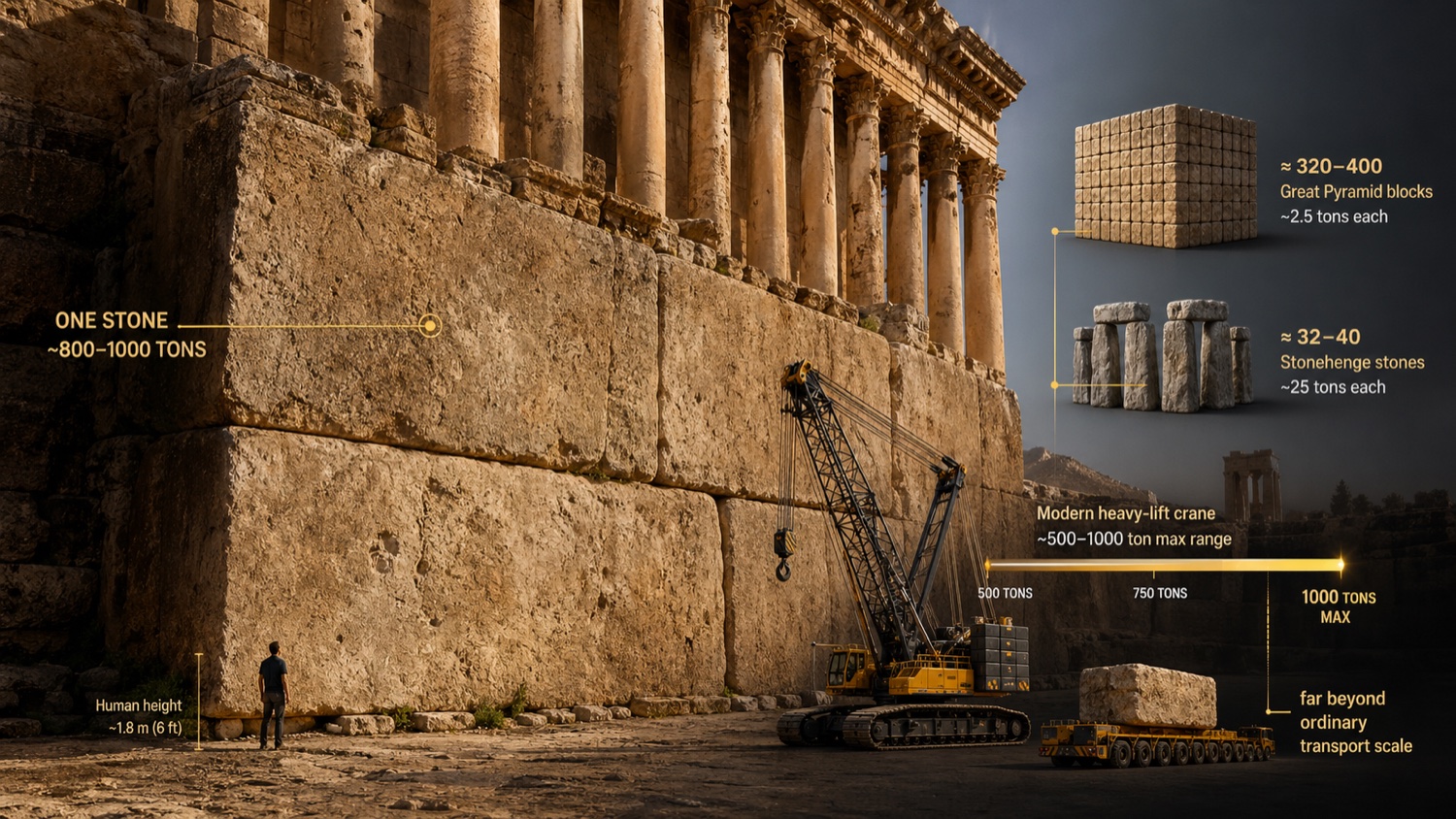
For reference: the largest stone in the Great Pyramid weighs 80 tons. The Baalbek stones are ten to twenty times heavier. The Trilithon stones were not only quarried but transported and lifted seven meters above ground level, then fitted with precision. The Maronite Patriarch of Lebanon preserved a tradition that Baalbek was built by Cain's descendants and "peopled with giants who were punished for their iniquities by the flood."
The Quran preserves a remarkable detail that most readers outside Islam never encounter. It describes two ancient civilizations, 'Ad and Thamud, who built structures so extraordinary that God Himself drew attention to them.
The people of 'Ad are described as giants of extraordinary strength. Surah Al-Fajr (89:6-8) says of their city Iram: "Have you not considered how your Lord dealt with 'Ad, Iram, who had lofty pillars, the likes of which had never been created in the land?" This is God, speaking through the Quran, confirming that a pre-Islamic civilization built monuments unprecedented in history. The people of 'Ad were described as being of extraordinary stature and physical power, and they were destroyed by God for their arrogance and rejection of the prophet Hud.
Thamud carved entire dwellings from solid rock mountains, Surah Al-Hijr (15:82) says they "carved houses out of the mountains, feeling secure." Their prophet Salih warned them, but they rejected him and were destroyed by a cataclysmic earthquake and blast. The rock-cut city of Mada'in Saleh (Al-Hijr) in modern Saudi Arabia, a UNESCO World Heritage site, is traditionally identified as the remnant of Thamud's civilization.
The Pattern Across Scriptures
The Bible describes the Nephilim and Rephaim as giants who built fortified cities, King Og's kingdom of Bashan was known for its massive stone structures. The Quran describes 'Ad and Thamud as physically powerful peoples who built monuments "the likes of which had never been created." The Mahabharata describes the Rakshasas, powerful, often gigantic beings who built Lanka, a city of extraordinary sophistication. Three scripture traditions, three continents, the same claim: an ancient race of exceptional physical power built monuments that later humanity could not replicate, and they were destroyed by divine judgment.
These sites share a pattern: the oldest construction is the most impressive, and later civilizations could not replicate it. This is the opposite of what gradual progress predicts. It is exactly what you would expect if advanced knowledge existed before a catastrophic reset, and was partially carried through by survivors, then gradually lost.
This isn't a Mediterranean quirk or an Egyptian coincidence. The same regression appears across the ancient world. The temples of the first dynasties dwarf what their successors could attempt. The earliest carvings are sharper, the earliest stones heavier, the earliest geometry tighter. Civilization, in the archaeological record, peaks early and slips downhill from there.
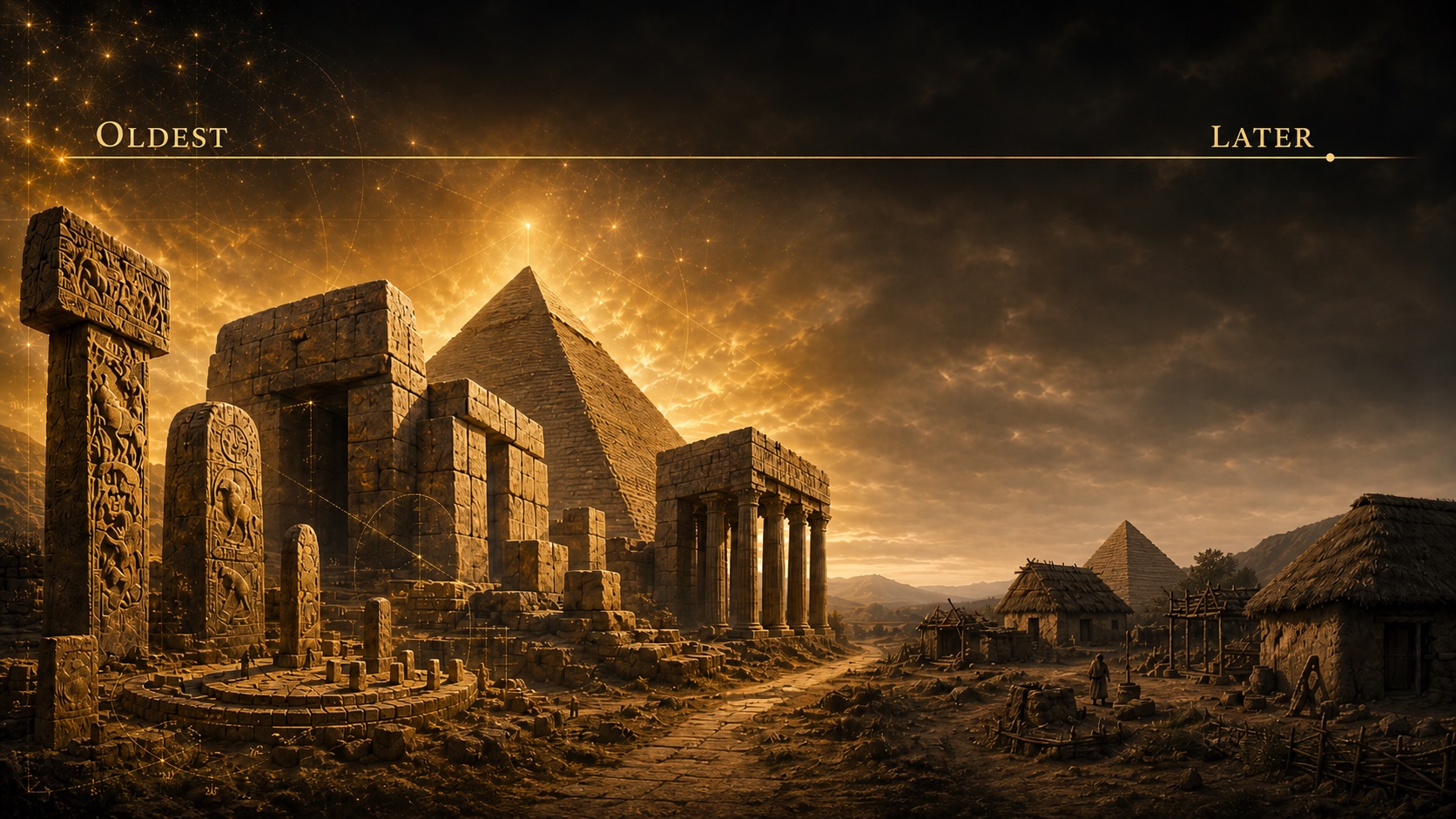
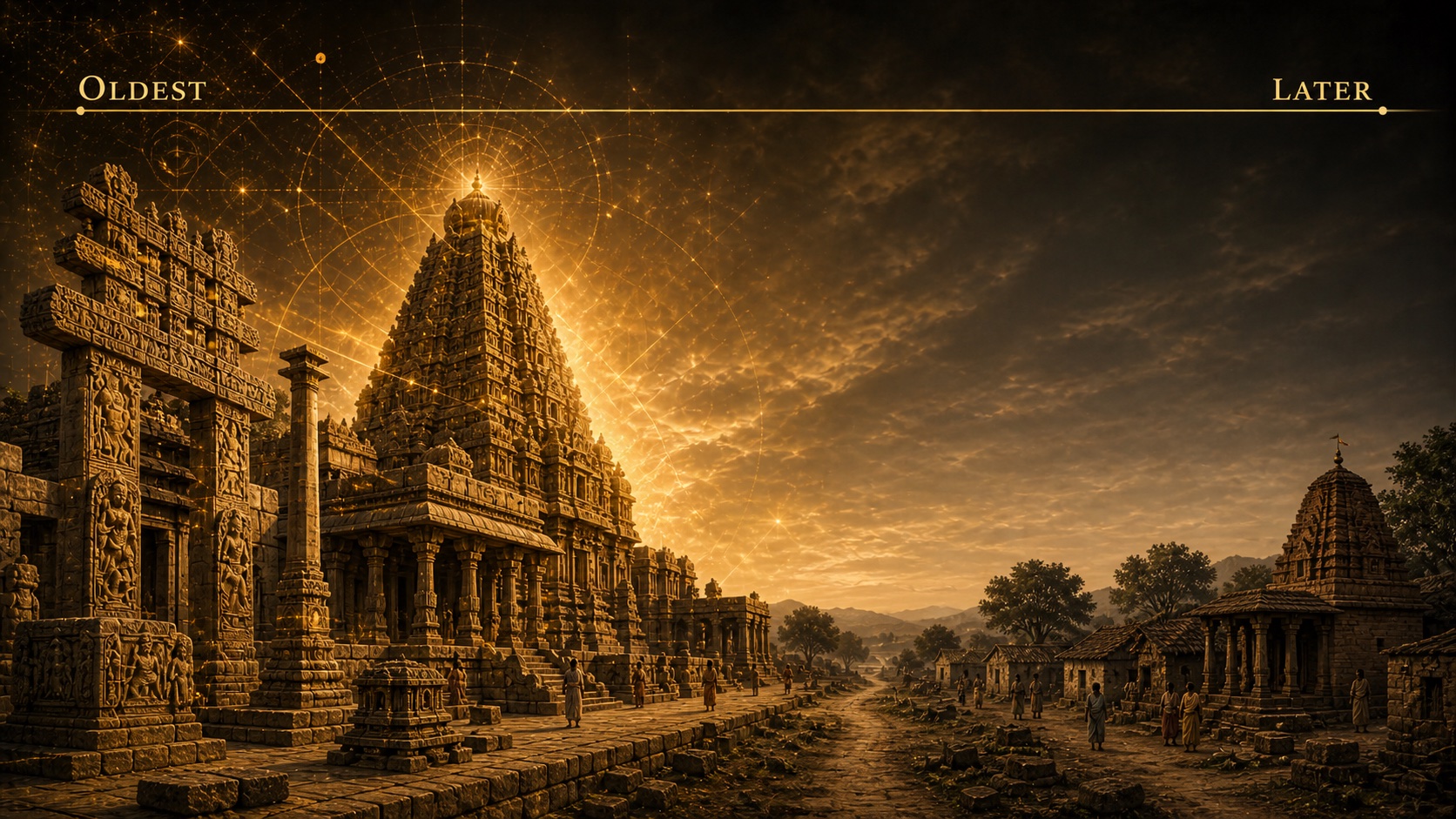
The Mesopotamian–Egyptian world begins with Göbekli Tepe and the Great Pyramid and ends with mud-brick villages. India begins with Dravidian temple complexes whose carvings still cannot be reproduced by hand and ends with simpler later-era shrines. Two unrelated civilizations, the same arrow, pointing the same way.
"Advanced" is a word that gets thrown around without definition. When applied to the oldest monuments, it points to four very specific things, each one measurable, each one still difficult to reproduce today.
Precision
The Great Pyramid's base is leveled within 21 millimeters across 230 meters, tighter than the laser-leveled foundations of modern skyscrapers. The Trilithon stones at Baalbek are joined so closely that a knife blade cannot pass between them. Göbekli Tepe's T-pillars carry animal reliefs in deep undercut relief, the kind of carving a steel chisel still finds difficult. We are not talking about good for their time; we are talking about tolerances that current construction would be proud to hit.
Astronomical Alignment
The Great Pyramid is oriented to true north within 3 minutes 6 seconds of arc, a sixteenth of a degree. Göbekli Tepe's enclosures track stellar positions including the rising of Sirius and the precession of constellations. Both predate any surveying instrument we know how to imagine for them. The builders were doing astronomy at a resolution that requires either centuries of recorded observation or instruments we have not found.
Longevity
The Great Pyramid stood as the tallest structure on earth for 3,800 years, until Lincoln Cathedral overtook it in 1311 CE. Baalbek's pre-Roman foundation has carried Roman, Byzantine, Arab and Crusader buildings on top of it for 2,000 years without subsidence. Modern reinforced concrete, by contrast, is rated for 50 to 100 years before it requires structural intervention. The oldest builders were designing for a permanence we do not even attempt.
Sheer Weight
This is the one that breaks the timeline outright. The three Baalbek Trilithon stones weigh roughly 800 tons each. The unfinished Stone of the Pregnant Woman in the same quarry weighs ~1,000 tons. The third monolith discovered in 2014 weighs ~1,650 tons. For comparison: the largest mobile crane on earth today, the Liebherr LTM 11200-9.1, can lift 1,200 tons at minimum boom radius. A single Trilithon stone is at the edge of modern lifting capacity. The 1,650-ton stone is past it.
The textbook reconstruction of ancient monument-building, wooden rollers, earthen ramps, copper chisels and disciplined rope teams, has been demonstrated in modern experimental archaeology for stones up to about 50 or 60 tons. It has never been demonstrated for stones above 100 tons. The Baalbek Trilithon is sixteen times heavier than the threshold at which our reconstructions stop working.
To put it concretely: a standard semi-truck carries about 25 tons. To move the smallest Trilithon stone across the 800-metre quarry-to-temple gap, you would need to coordinate the lifting force of thirty-two semi-trucks moving in lockstep, and that is just to nudge it horizontally. To then lift it seven metres into the foundation wall and seat it within millimetres of its neighbour, you need leverage of a kind we associate with hydraulic systems that did not exist until the 19th century. The conventional explanation, when pushed, is essentially that we do not have one.
The oldest visible structures in two unrelated civilizations are, in both cases, the most demanding pieces of engineering those civilizations ever produced. Everything that comes after is smaller, lighter, simpler. The skill that built them is no longer present in the people who lived on top of them. The arrow runs the wrong way, and the only frameworks that comfortably accommodate it are the ones that say something was lost.
Chapter Three
"The sons of God saw that the daughters of men were beautiful, and they took wives for themselves, whomever they chose... The Nephilim were on the earth in those days, and also afterward, when the sons of God came to the daughters of men, and they bore children to them. These were the mighty men of old, men of renown."
Genesis 6:2–4Genesis 6 describes an event that most modern readers find shocking: divine beings, called "sons of God" (bene Elohim), descended to earth, took human women as wives, and produced offspring called the Nephilim: mighty warriors, men of extraordinary fame. The Book of Enoch, preserved in the Ethiopian Orthodox canon and found among the Dead Sea Scrolls, expands the account: 200 angels called Watchers descended to Mount Hermon, took human wives, and taught humanity forbidden knowledge, metallurgy, weapons, cosmetics, astrology, enchantments.
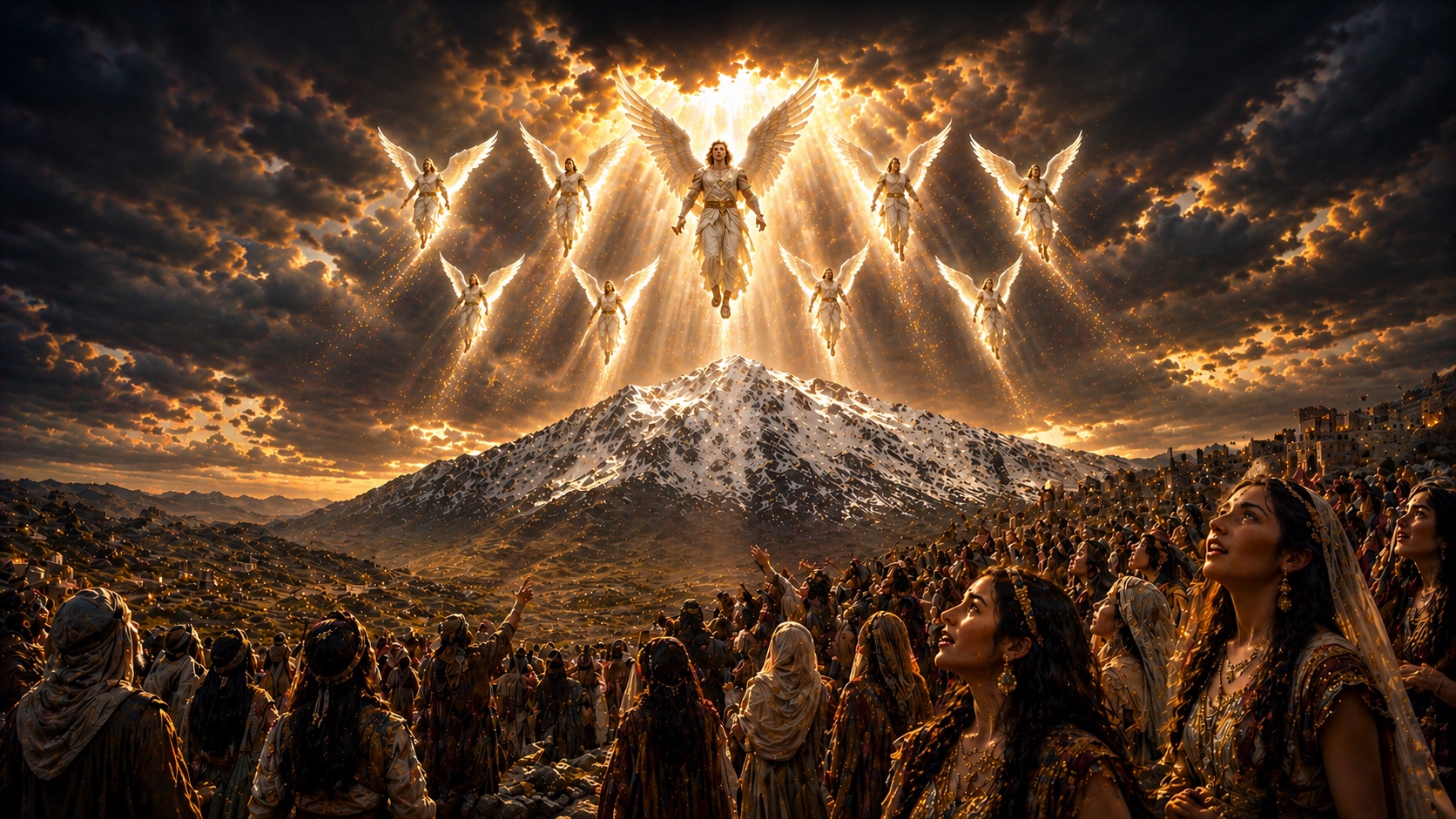
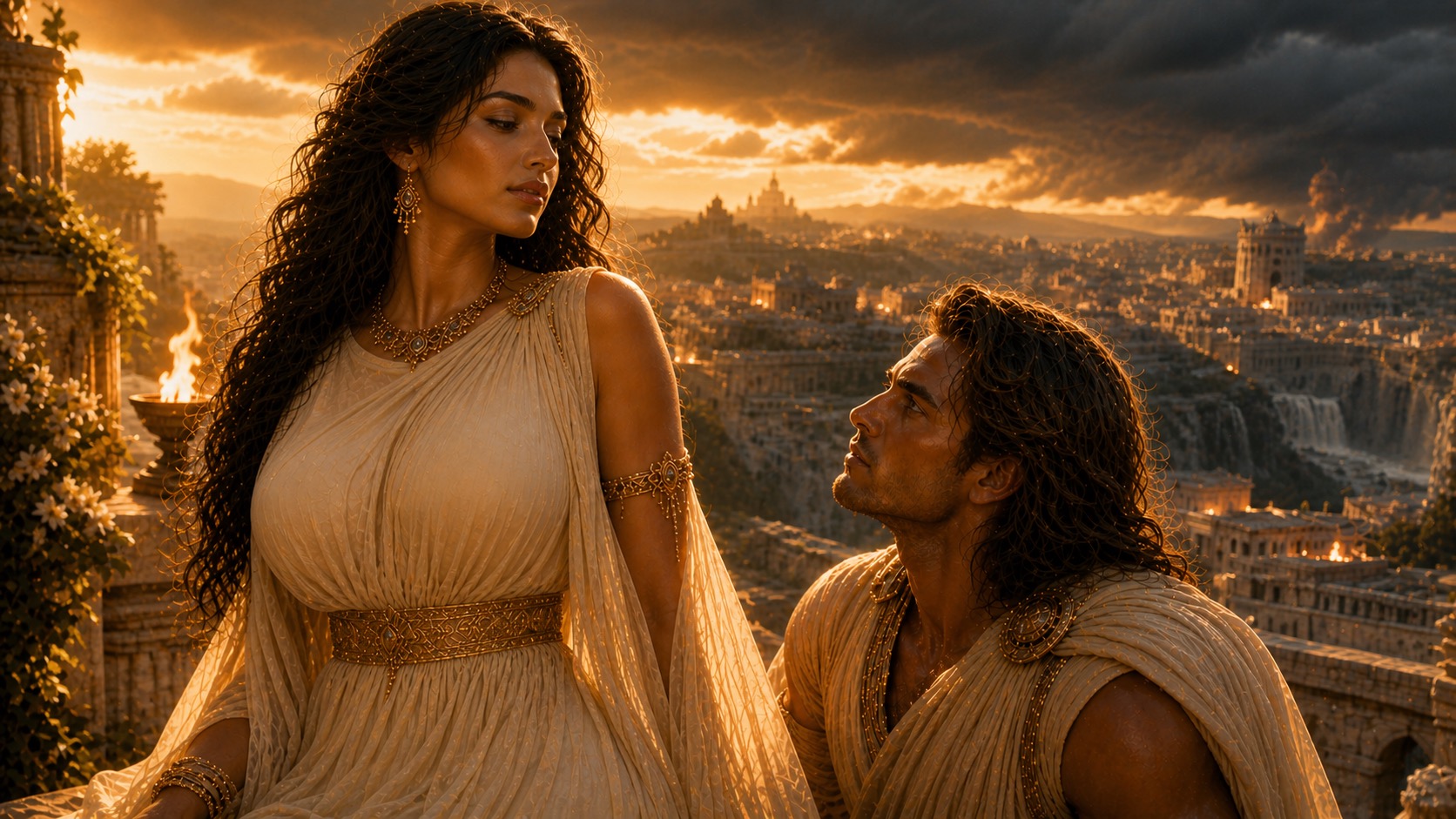
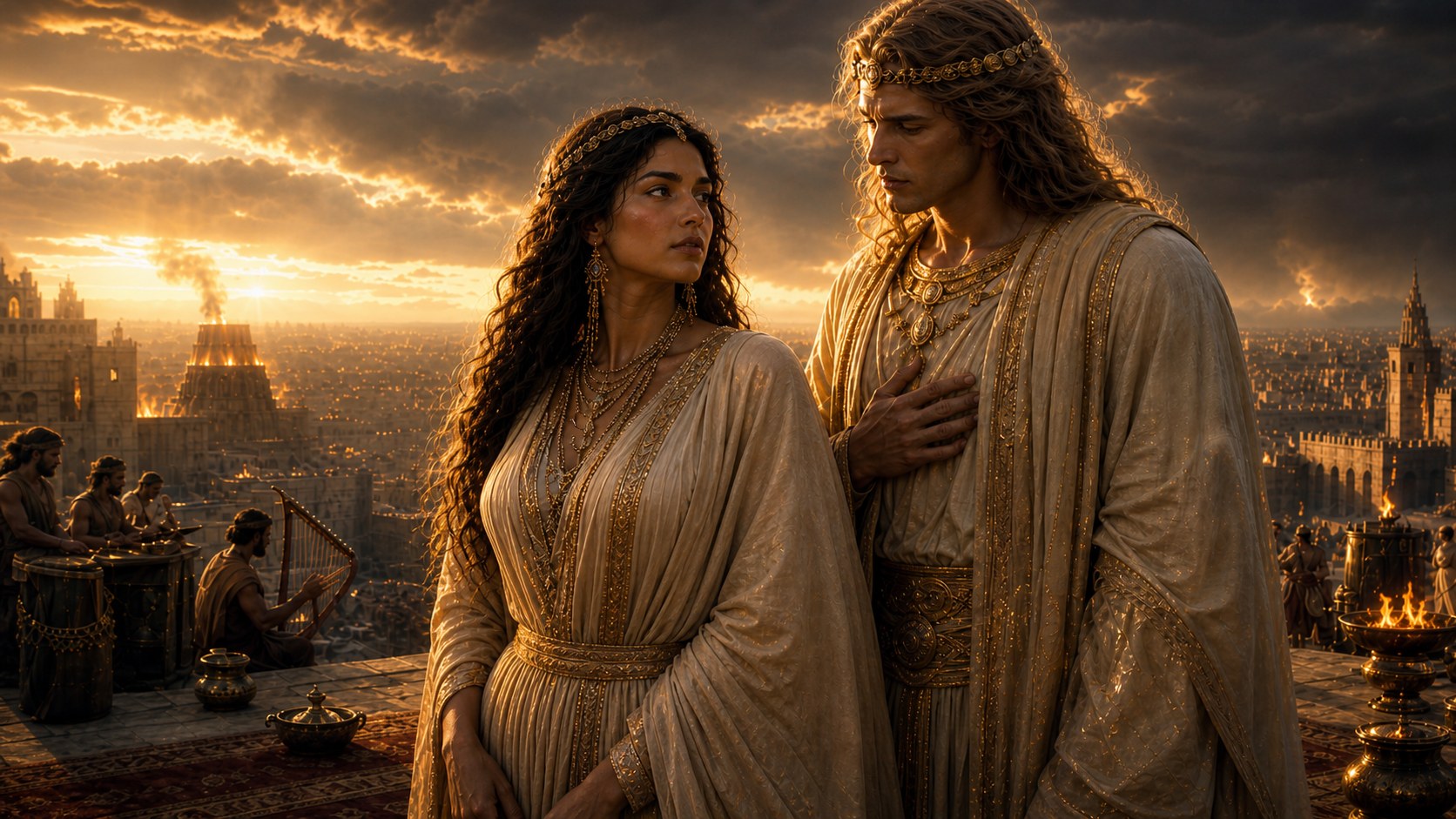
But who were these women? Genesis says only that the "daughters of men" were beautiful. The Book of Enoch adds that they were "fair and beautiful daughters" born as humanity multiplied. The text does not name them individually, but Jewish rabbinic tradition fills in a crucial detail: the women were from the line of Cain.
This matters. Cain's lineage had already turned away from God after the murder of Abel. By the time of the Watchers' descent, Cain's descendants had built cities, invented instruments of war and pleasure, and produced a culture defined by pride and violence. Lamech, Cain's descendant, boasted to his two wives that he had killed a man for wounding him. These were the families the Watchers chose.
The Watchers did not descend into a blank, innocent world. They descended into a civilization Cain had already built, where the orchestra of corruption was already tuned: the first city, the first forge of weapons, the first music weaponised for seduction, the first boast about murder. The forbidden knowledge they transmitted was not new to humanity. It was already being practiced by the family they joined.
Most readers move past Genesis 4 quickly. But buried in those few verses is the founding of every art the Watchers would later teach. Cain's lineage didn't drift into corruption, it engineered it.
Cain, The First City Builder
Genesis 4:17: "Cain knew his wife, and she conceived and bore Enoch. And he built a city, and called the name of the city after the name of his son, Enoch." The very first city in scripture is built by the first murderer. Civilization itself, in Genesis, begins not with worship but with a man hiding from God behind walls. Every later "first city" memory in human civilization, Eridu in Sumer, Memphis in Egypt, descends from this template.
Tubal-Cain, The First Forger of Weapons
Genesis 4:22: "Tubal-Cain was an instructor of every craftsman in bronze and iron." The first metallurgy in scripture is forged inside Cain's bloodline. Centuries later, the Book of Enoch will name Azazel as the Watcher who taught humanity "the art of making weapons of war, swords, knives, shields, breastplates", the exact same craft. Tubal-Cain's sister was Naamah. Azazel was the Watcher who fell for her. The forbidden knowledge the Watchers transmitted was not new to humanity, it was already being practiced by the family they joined.
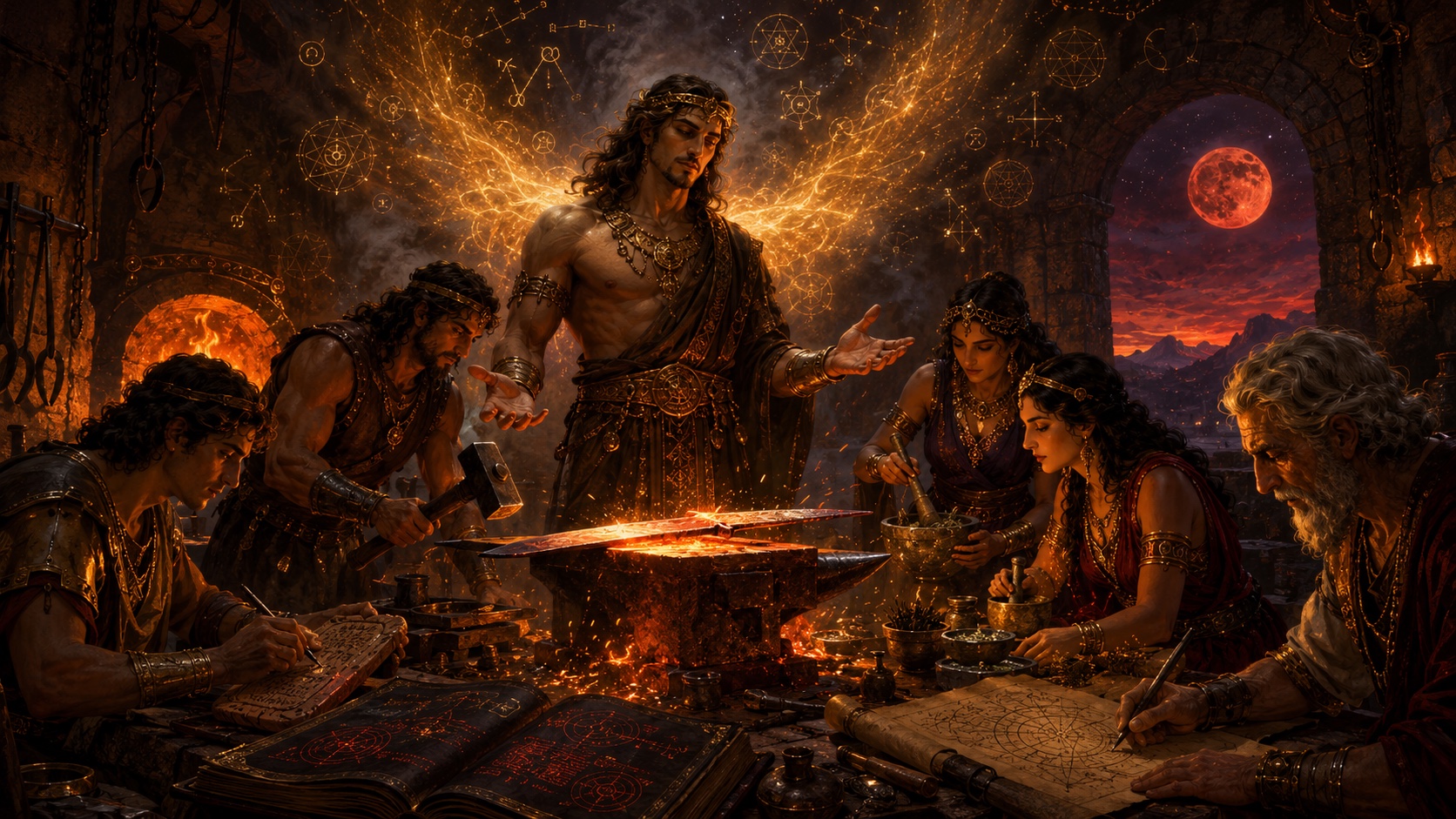
Jubal, The First Musician
Genesis 4:21: "Jubal was the father of all those who play the harp and flute." Music itself, in Genesis, originates from Cain's line. Naamah, Tubal-Cain's sister, is later remembered in rabbinic tradition as the cymbalist who drew souls to idolatry through song. Music becomes the first art to be weaponized for spiritual seduction. The Watchers, when they descended, did not have to invent these tools. The orchestra of corruption was already tuned.
Lamech, The First Boasting Murderer
Genesis 4:23–24: "Lamech said to his wives, 'Adah and Zillah, hear my voice; wives of Lamech, listen to my speech! For I have killed a man for wounding me, even a young man for hurting me. If Cain shall be avenged sevenfold, then Lamech seventy-sevenfold.'" Cain killed once and was ashamed. Lamech kills and writes a poem about it. This is the trajectory inside one bloodline, over six generations, murder transforms from sin to art. By the time the Watchers arrived, this was the soundtrack of the world's first civilization.
So when Genesis 6 says the sons of God saw the daughters of men and "took for themselves wives of all whom they chose," this is the pool they were choosing from. The Watchers didn't fall into a virgin world. They fell into a civilization Cain had already built, and they perfected what was already underway.
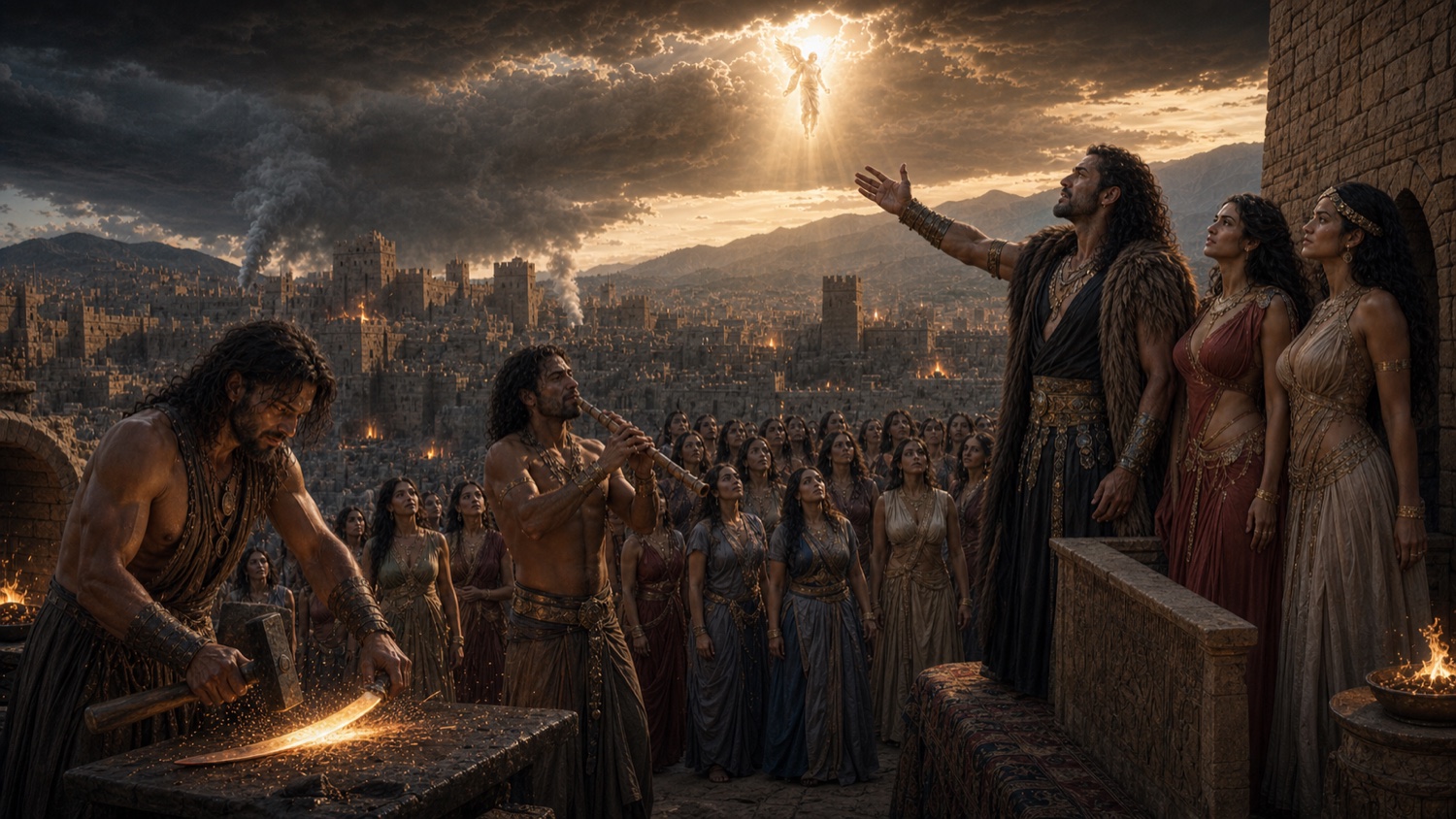
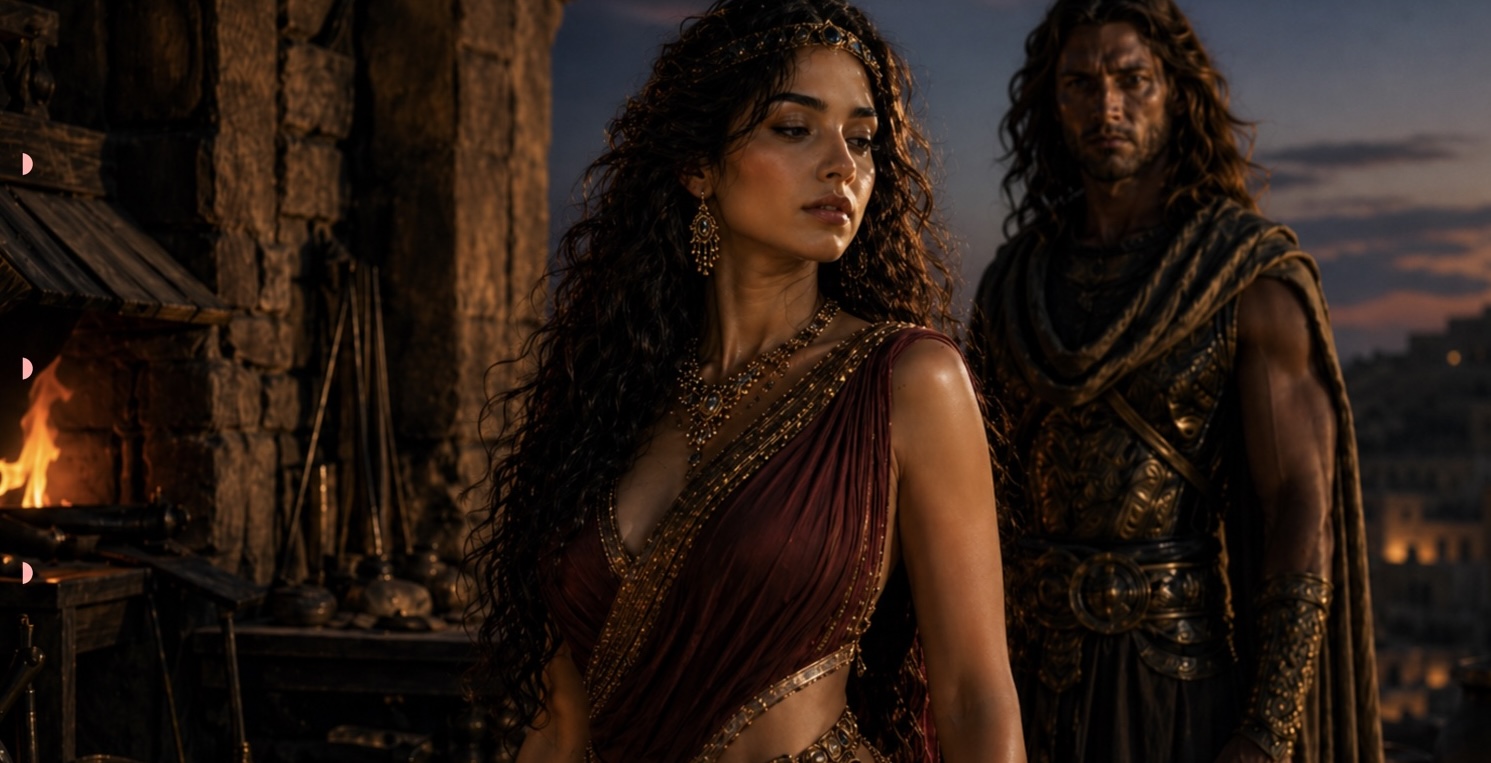
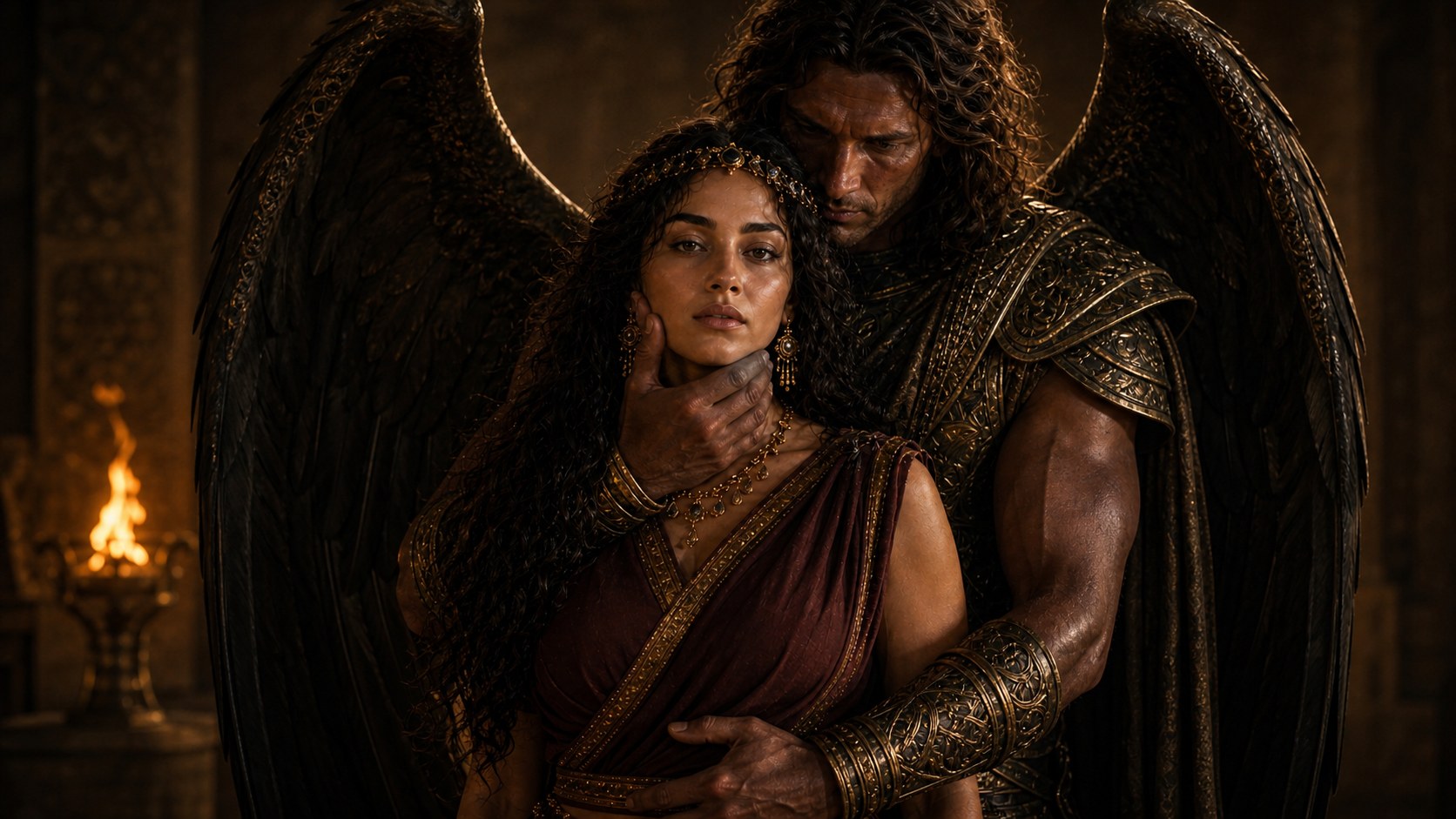
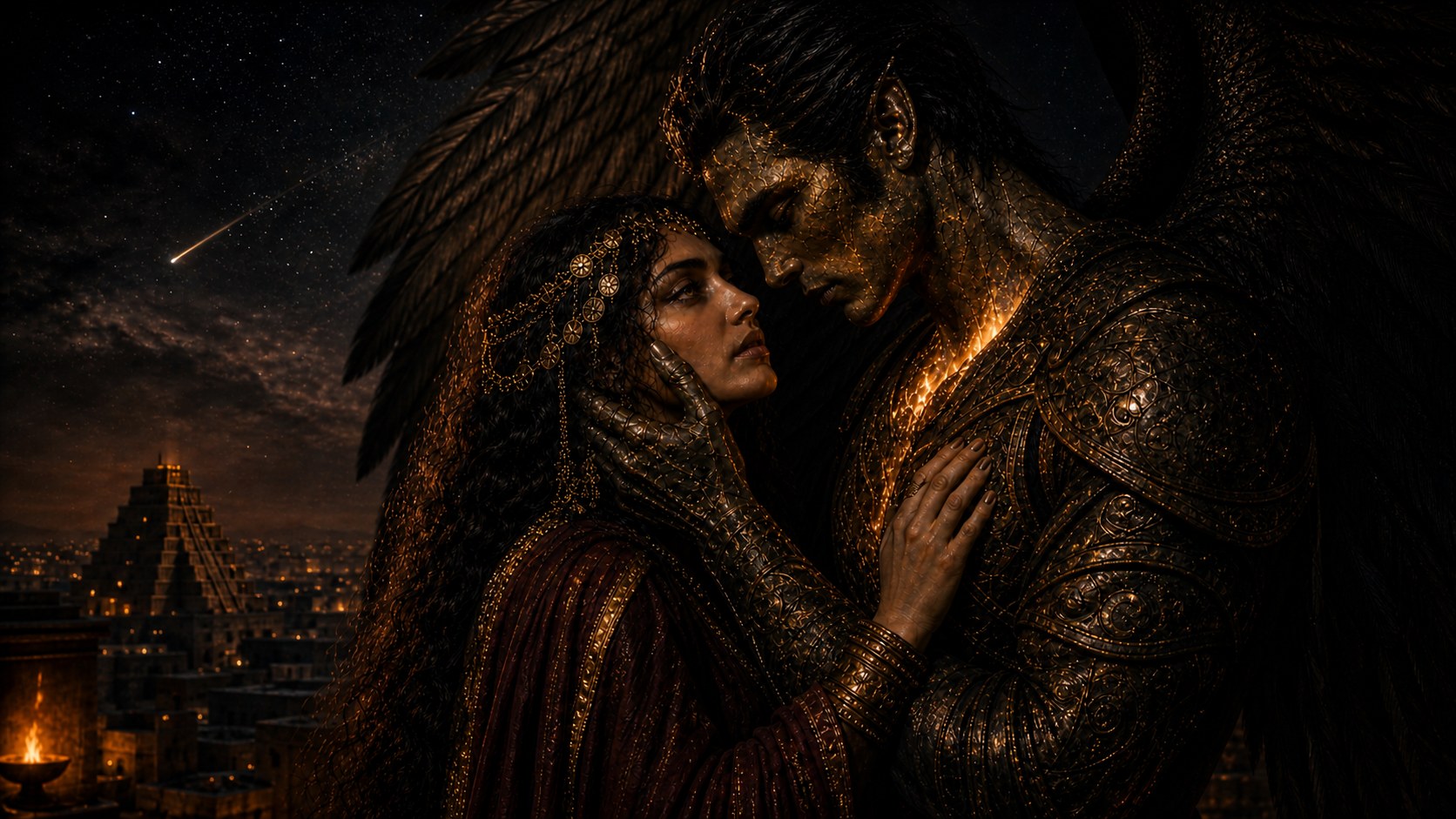
One woman stands out: Naamah, the sister of Tubal-Cain, the forger of weapons and tools. She is the only woman mentioned by name in the Cainite genealogy of Genesis 4:22, and scholars have long asked why. The Midrash provides an answer: Naamah was so extraordinarily beautiful that the angels themselves fell for her. The Zohar, the foundational text of Jewish mysticism, states explicitly that Naamah and Lilith corrupted the Watchers Ouza and Azazel. In rabbinic tradition, Naamah's name means "pleasant" or "singer"; she was said to play cymbals and draw people toward idolatry through music and beauty.
Naamah, The Woman Who Enticed the Angels
According to Midrash ha-Gadol, Naamah was "the most beautiful woman in the world, so much so that she caused the ministering angels to fall prey to her loveliness, for they thought she was one of them." The Zohar says she and Lilith seduced the Watchers Azazel and Ouza. Some traditions identify her as Noah's wife, a righteous woman who survived the flood. Others portray her as the origin of demonic lineages. Her brother Tubal-Cain forged weapons; Azazel, the Watcher she is linked to, taught humanity the same art. The family connection is striking: the Watchers didn't just take random women. They were drawn to the lineage that already possessed forbidden knowledge.
Notice the pattern across civilizations: Kunti in the Mahabharata also received divine visitors, but she invoked the Devas deliberately, using a boon she had been given. In Greek mythology, Zeus took mortal women, Alcmene (mother of Heracles), Danaë (mother of Perseus), Leda (mother of Helen), all specifically chosen for their beauty or lineage. The Norse tradition tells of Freya, desired by giants and gods alike. In every civilization, the same story: divine beings are drawn to specific mortal women of extraordinary beauty, and the unions produce superhuman offspring who reshape history.
Their offspring were violent giants. The corruption spread until God determined to cleanse the earth with a flood.
This is not a story unique to the Bible. It is, perhaps, the most widely attested narrative in all of human civilization. And the parallels are not vague, they are structurally precise.
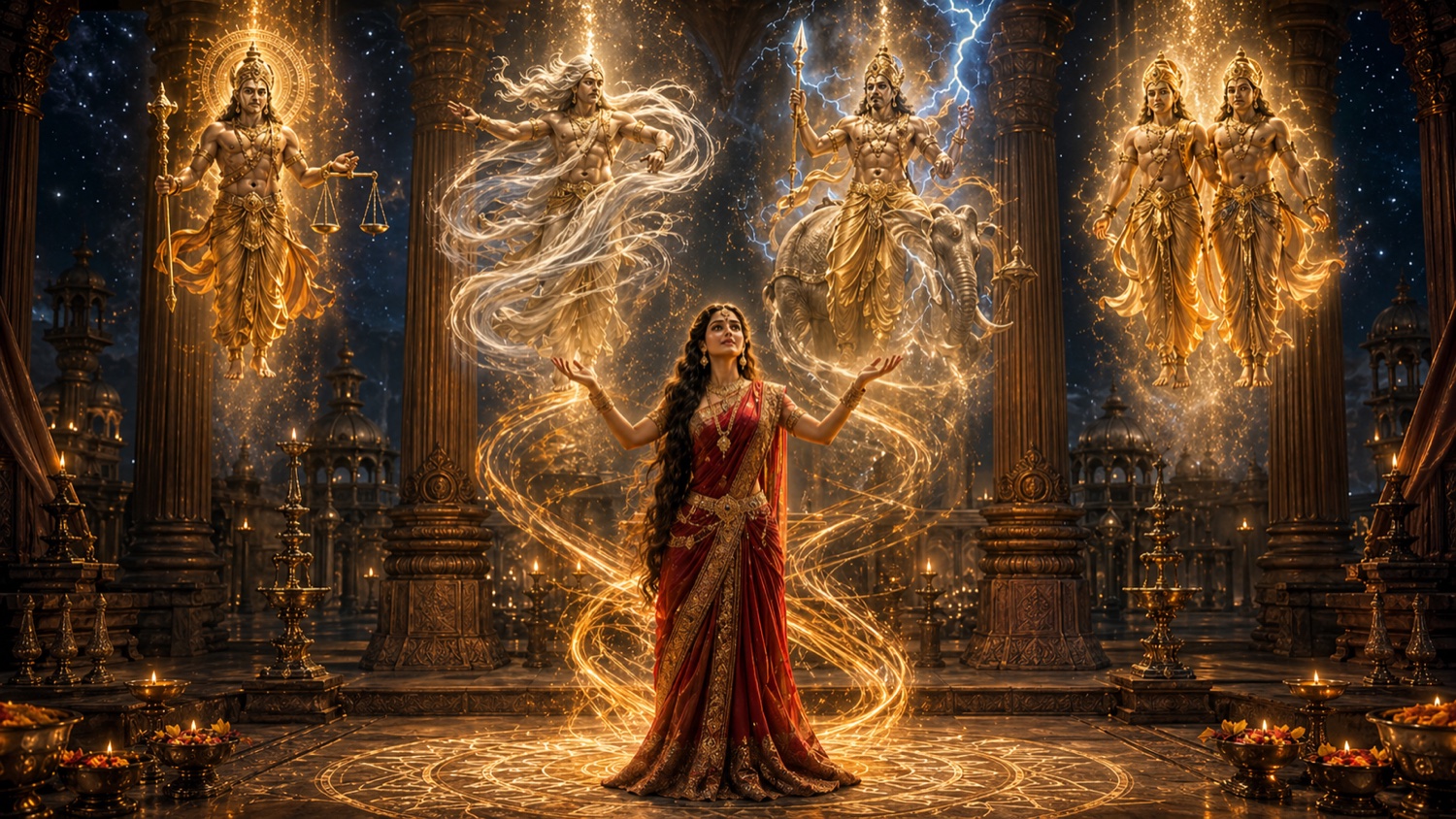
In the Mahabharata, the five Pandavas, the greatest warriors in Indian epic literature, were fathered by gods. Yudhishthira by Dharma, the god of justice. Bhima by Vayu, the wind god. Arjuna by Indra, king of the gods. The twins Nakula and Sahadeva by the Ashvins, divine healers. Each son inherited superhuman attributes from his divine father. They were, in the Bible's language, "mighty men of old, men of renown."
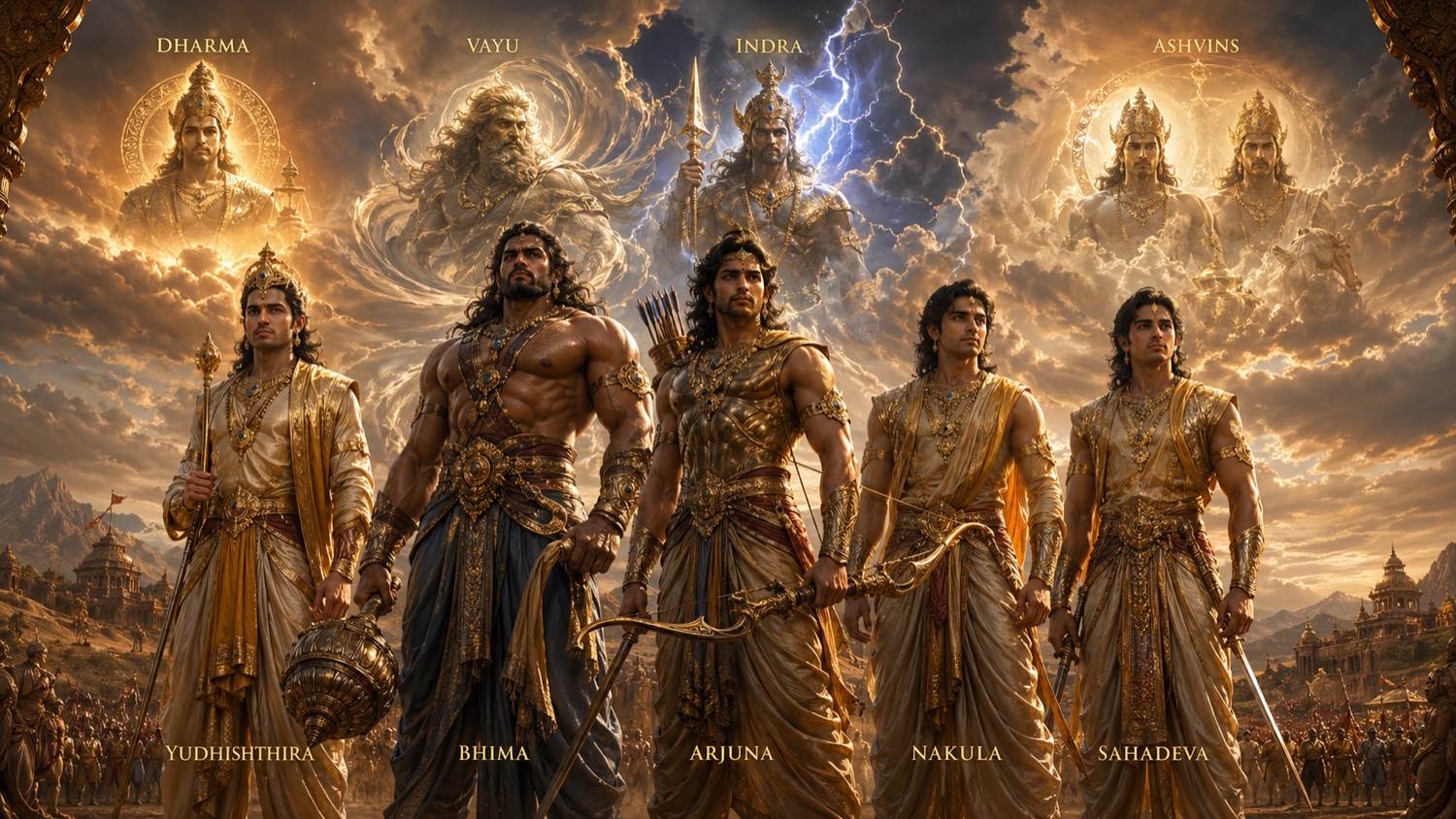
The Kurukshetra War that these divine-human warriors fought didn't just end a dynasty. According to Hindu cosmology, it ended an age, the Dvapara Yuga, and ushered in the Kali Yuga, the age of decline. The Bible says the Nephilim era ended with the Flood, which also transitioned humanity into a diminished age of shorter lifespans and harder conditions. Both narratives describe divine-human hybridization leading to a civilization-ending cataclysm that resets the world.
Note the Greek connection carefully. The apostle Peter, a Jewish fisherman writing about the fallen angels' punishment, chose a Greek word: Tartarus. Not Sheol, not Gehenna, Tartarus, the specific prison where Greek mythology said the Titans were chained after their rebellion. Either Peter borrowed Greek mythology, or the Greeks preserved a corrupted memory of the same event Peter was describing.
The Norse told the same story: primordial giants called Jötnar, born at the dawn of creation, who war against the gods and bring about Ragnarök, a final apocalyptic battle that destroys and resets the world, followed by a flood. The Quran describes the people of 'Ad as giants whose arrogance provoked divine destruction, and calls them jabbarin, likely a direct cognate of the Hebrew gibborim from Genesis 6:4.
But the Islamic parallel goes far deeper than the giants. Surah Al-Baqarah (2:102) describes two angels, Harut and Marut, who were sent down to Babylon and taught people forbidden knowledge: sorcery, how to cause division between husband and wife, and other dark arts. But the Quran adds a detail that should arrest every reader: before teaching anyone, Harut and Marut explicitly warned, "We are only a trial, so do not disbelieve."
Read that again. Two angels. Sent to Babylon. Teaching forbidden knowledge to humans. While acknowledging that what they were doing was a test from God. This is not vaguely similar to the Watcher narrative, it is structurally identical. The location is the same (Babylon/Shinar). The action is the same (teaching forbidden arts). And the moral framework is the same: the angels knew they served a higher authority even as they participated in humanity's corruption.
Idris, The Prophet Who Documented the Watchers
The Quran honors a prophet named Idris, described in Surah Maryam (19:56-57) as "a man of truth, a prophet" who was "raised to a high station." Muslim scholars have widely identified Idris with the biblical Enoch, the same figure who, in 1 Enoch, documented the Watchers' descent, recorded their names and crimes, and carried their failed petition to God. This means the prophet who wrote the most detailed account of the fallen angels is honored in Islam, Christianity (Jude 1:14 quotes Enoch directly), and Judaism alike. Three Abrahamic traditions revere the man who told this story, yet most people in all three traditions have never read what he actually wrote.
Every ancient civilization tells the same story: powerful beings came down, they produced extraordinary offspring, they gave us knowledge we weren't ready for, and then everything was destroyed so the world could start over.
But here is a detail that changes everything: the Watchers knew exactly who God was. They never claimed to be the highest authority. They never denied the Creator above them. Their rebellion was not born of ignorance, it was born of defiance despite full knowledge. The Book of Enoch records the oath they swore before descending, the petition for mercy they begged Enoch to carry to God, and their silent submission when the archangels came to bind them. Whatever power they had, they knew it was derivative. They were servants who went rogue, not rival gods.
The Oath on Mount Hermon, 1 Enoch 6
Before they descended, their leader Semjaza hesitated. He told the others: "I fear that you will not agree to do this deed, and I alone will pay for this great sin." He knew it was sin. He knew there would be a penalty. He knew who would impose it. The other 199 Watchers then swore a mutual oath, binding themselves together so no one could back out. This was not confusion, it was calculated rebellion by beings who understood the hierarchy they were violating.
The Petition Through Enoch, 1 Enoch 13–16
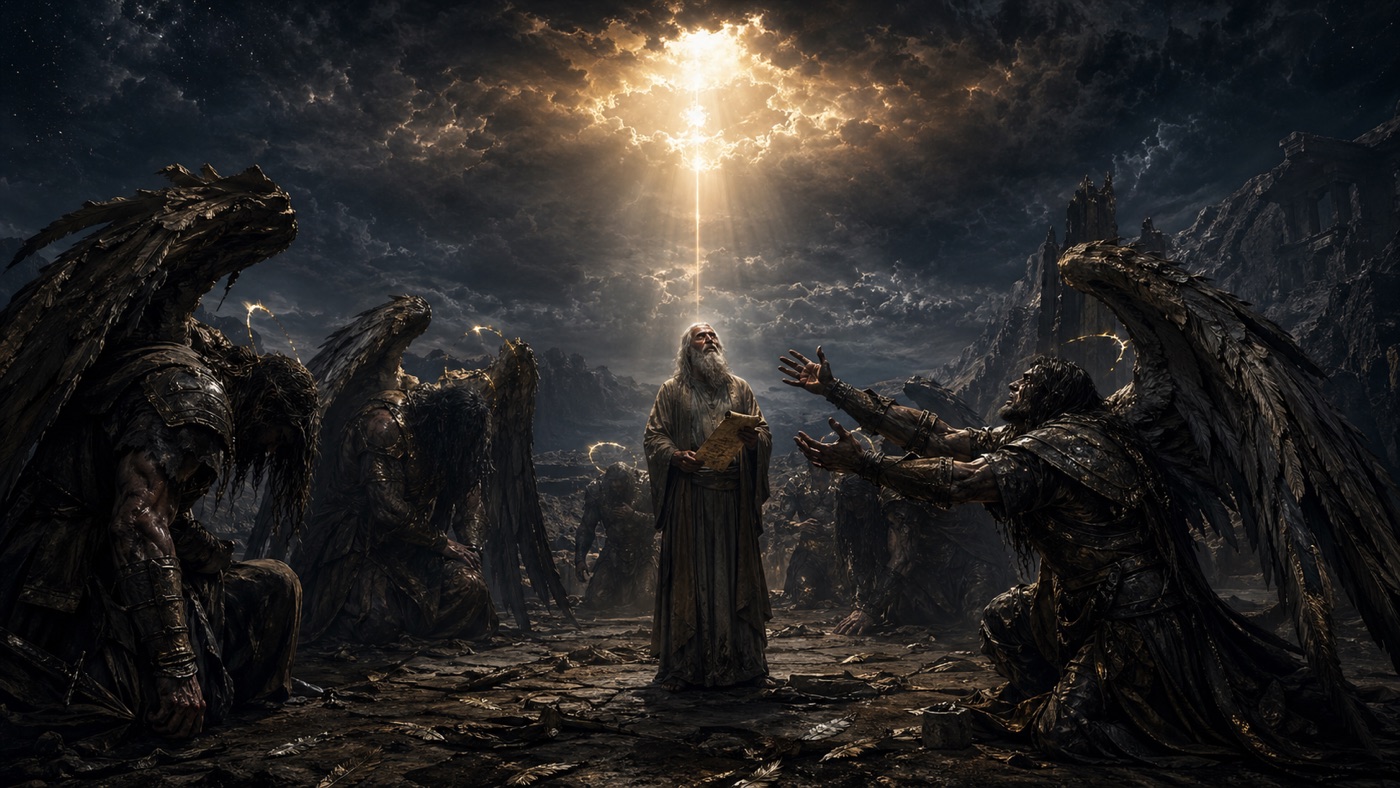
After their condemnation, the Watchers begged Enoch, a human being, to intercede with God on their behalf. They asked him to write a petition of mercy and present it to "the Lord of heaven." These supposedly powerful divine beings could no longer approach God themselves. They were reduced to asking a mortal man to pray for them. God's response was devastating: "You were spiritual beings in heaven. You had eternal life. You needed no wives or children. You abandoned your proper domain. Your petition is denied." The Watchers accepted this verdict. There is no record of them arguing back or claiming equality with God.
The Binding, 1 Enoch 10
God sent His archangels, Raphael, Michael, Gabriel, Uriel, to bind the Watchers and imprison them in darkness until the final judgment. The Watchers did not resist. They did not fight back. They were simply bound. Whatever power they had, they knew it was derivative. They were servants who went rogue, not rival gods.
The New Testament book of Jude draws an explicit line between the fallen Watchers and the cities of Sodom and Gomorrah, naming them in the same breath, charging them with the same crime, and citing them as a single warning:
"And the angels who did not keep their proper domain, but left their own abode, He has reserved in everlasting chains under darkness for the judgment of the great day; as Sodom and Gomorrah, and the cities around them in a similar manner to these, having given themselves over to sexual immorality and gone after strange flesh, are set forth as an example, suffering the vengeance of eternal fire."
Jude 1:6–7
Jude is not making a loose comparison. He is naming a single category of sin, beings (or people) crossing into what God explicitly forbids, and identifying both the Watchers and Sodom as receiving the same kind of judgment for it. The pattern is consistent: corruption beyond a certain threshold triggers fire from heaven.
Tall el-Hammam, The Archaeology of Sodom
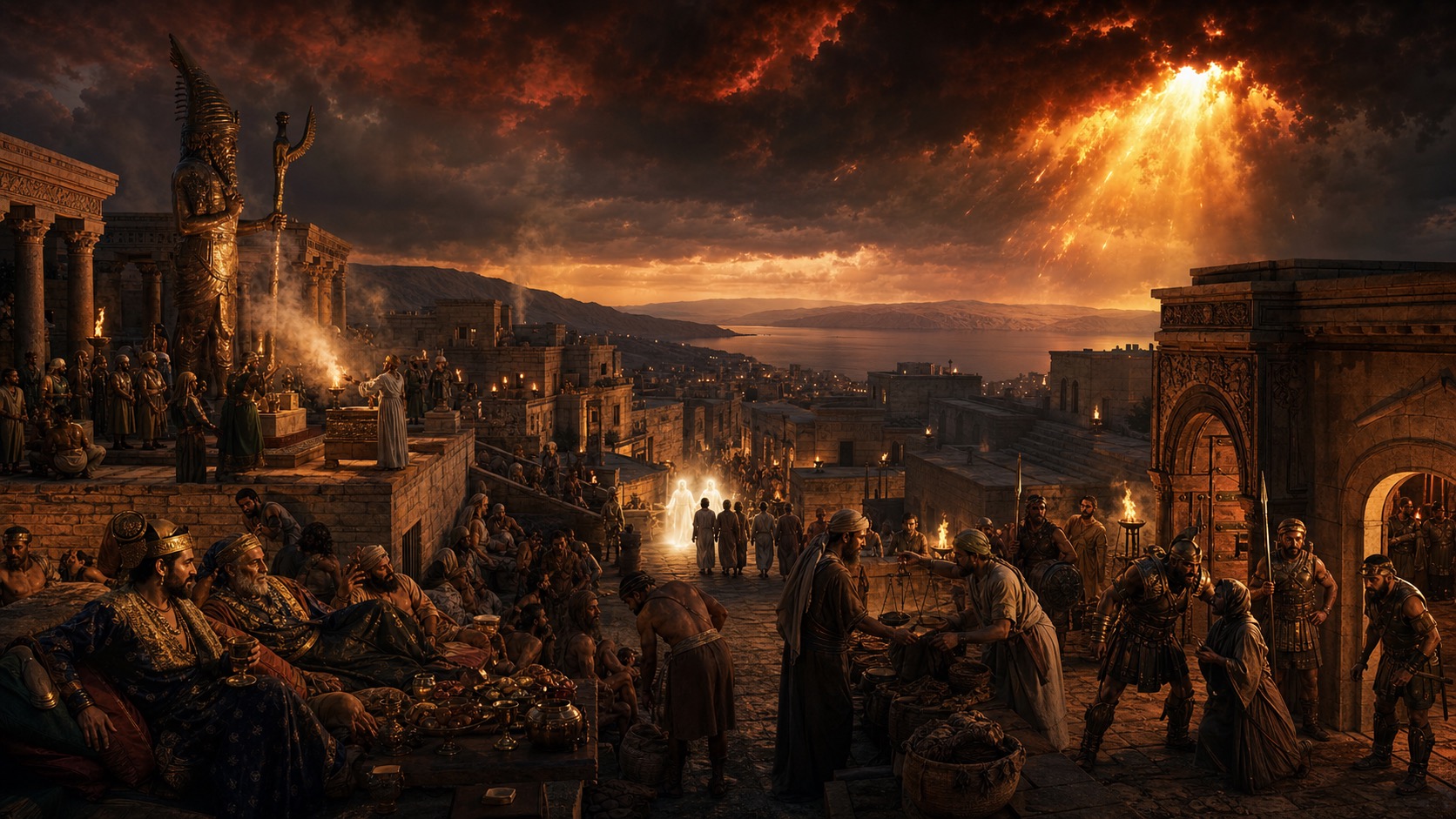
In 2021, a team of 21 researchers published a peer-reviewed study in Scientific Reports (Nature Publishing Group) describing the destruction of Tall el-Hammam, a thriving Bronze Age city north of the Dead Sea, at approximately 1650 BCE. The evidence includes melted pottery, vaporized mudbrick, shocked quartz, diamond-like carbon spherules, and salt-saturated soil consistent with a cosmic airburst roughly 1,000 times the energy of the Hiroshima bomb. The city was uninhabited for 600 years afterward. The location and timing match the biblical account of Sodom precisely. The lead authors carefully avoid theological claims, but the physical evidence aligns so closely with Genesis 19 ("the Lord rained brimstone and fire from the Lord out of the heavens") that it is now openly discussed in the archaeological literature as a possible source for the Sodom narrative.
One man and his family were warned. Lot was led out before the fire fell. Noah was warned before the Flood. Both escapes follow the same divine pattern: judgment is coming, but the righteous are given a way out. The God who condemns is also the God who warns.
This is not a fringe interpretation of Genesis 6. It is what mainstream Jewish scholarship believed for centuries.
Flavius Josephus, the first-century Jewish historian whose works are among the most cited ancient sources in Western scholarship, wrote in his Antiquities of the Jews that "many angels of God accompanied with women, and begat sons that proved unjust, and despisers of all that was good, on account of the confidence they had in their own strength; for the tradition is, that these men did what resembled the acts of those whom the Grecians call giants." Josephus explicitly connects the Genesis 6 account to the Greek Titan traditions, a first-century historian making the same cross-civilization argument you are reading on this page.
He also recorded that the descendants of Seth, anticipating the coming judgment, inscribed their accumulated knowledge on two pillars, one of brick, one of stone, so that it would survive whether the destruction came by flood or fire. This pre-Flood knowledge preservation tradition echoes the Enochic framework: advanced knowledge existed before the catastrophe, and deliberate efforts were made to carry it through.
The Book of Giants, Dead Sea Scrolls
Found at Qumran among the Dead Sea Scrolls (dated roughly 200-100 BCE), the Book of Giants names individual Nephilim, Ohya and Hahya, sons of the Watcher Shemhazai, and describes their prophetic dreams of their own coming destruction. They dream of a tablet being submerged in water (the Flood), and of a garden with every tree being uprooted. They bring these dreams to Enoch for interpretation, and Enoch confirms: judgment is coming. The Nephilim knew they were going to be destroyed. This text was important enough to be preserved alongside Isaiah, Psalms, and the Torah scrolls at Qumran, Jewish scribes in the second century BCE considered this real history, not legend.
The Targums, Ancient Synagogue Translations
The Aramaic Targums, translations of the Hebrew Bible read aloud in ancient synagogues, identify the fallen angels by name: Shemhazai and Azael. Targum Pseudo-Jonathan on Genesis 6:4 reads: "Shemhazai and Azael fell from heaven and were on earth in those days." These were not marginal texts. They were read in synagogues across the Jewish world for centuries. The Watcher narrative was not a secret tradition, it was mainstream Jewish understanding of Genesis 6 until the medieval period, when rabbinic authorities began reinterpreting "sons of God" as human rulers to distance Judaism from the angelic reading.
This matters profoundly. The "gods" that every ancient civilization worshipped, the Devas, the Anunnaki, the Titans, the Olympians, were never gods at all. They were rebellious subordinates who never denied the existence of the true God. They just did not want you to know about Him. Every pantheon in human history may be a memory of the same group of fallen servants, renamed and elevated by the civilizations they deceived.
The secular explanation is that these are independent myths arising from universal human imagination. But myths about flooding rivers don't produce narratives about divine beings mating with human women, producing a race of superhuman warriors, teaching forbidden arts, and provoking a cataclysmic divine judgment. The specificity of the shared pattern demands a shared source.
Chapter Four
Over 200 distinct flood narratives have been documented across cultures worldwide. Not 200 stories about rivers overflowing, 200 stories about divine judgment destroying all of humanity, with a small remnant surviving to rebuild.
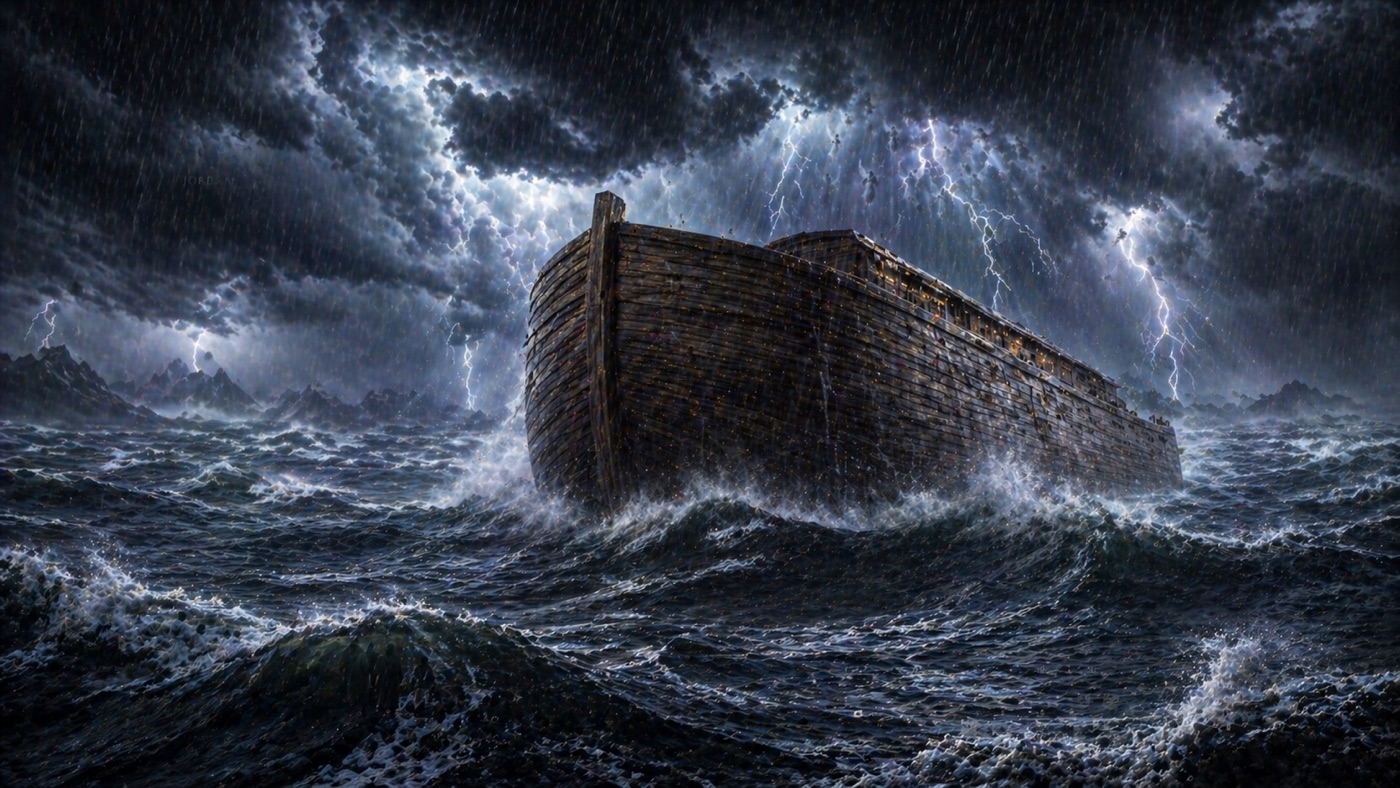
The core shared elements are remarkably consistent across civilizations that had no known contact with each other:
The flood is not a natural disaster. It is deliberate. God or the gods decide humanity has become irredeemably corrupt and must be cleansed. This element appears in the Bible, the Epic of Gilgamesh, the Hindu Matsya Purana, Greek mythology, Norse mythology, and dozens of indigenous traditions.
Noah in Genesis. Utnapishtim in the Epic of Gilgamesh. Manu in the Matsya Purana. Deucalion in Greek mythology. Ziusudra in Sumerian tradition. Gun-Yu in Chinese mythology. In every case, one man is chosen because of his righteousness and given advance warning.
An ark, a boat, a chest. The specific design varies, but the concept is identical: a sealed vessel large enough to preserve life through the catastrophe. The Bible, Gilgamesh, and Hindu accounts all specify construction details.
Noah saves his family and animals. Utnapishtim saves his relatives and "the seed of all living creatures." Manu preserves seeds of all living things. The scope of preservation is always comprehensive, not just human survival, but the continuation of all life.
Ararat (Bible). Mount Nisir (Gilgamesh). Malaya mountain (Hindu). Mount Parnassus (Greek). After the waters recede, the survivor lands on high ground and offers a sacrifice of gratitude. The Noah and Gilgamesh accounts share this detail almost word for word.
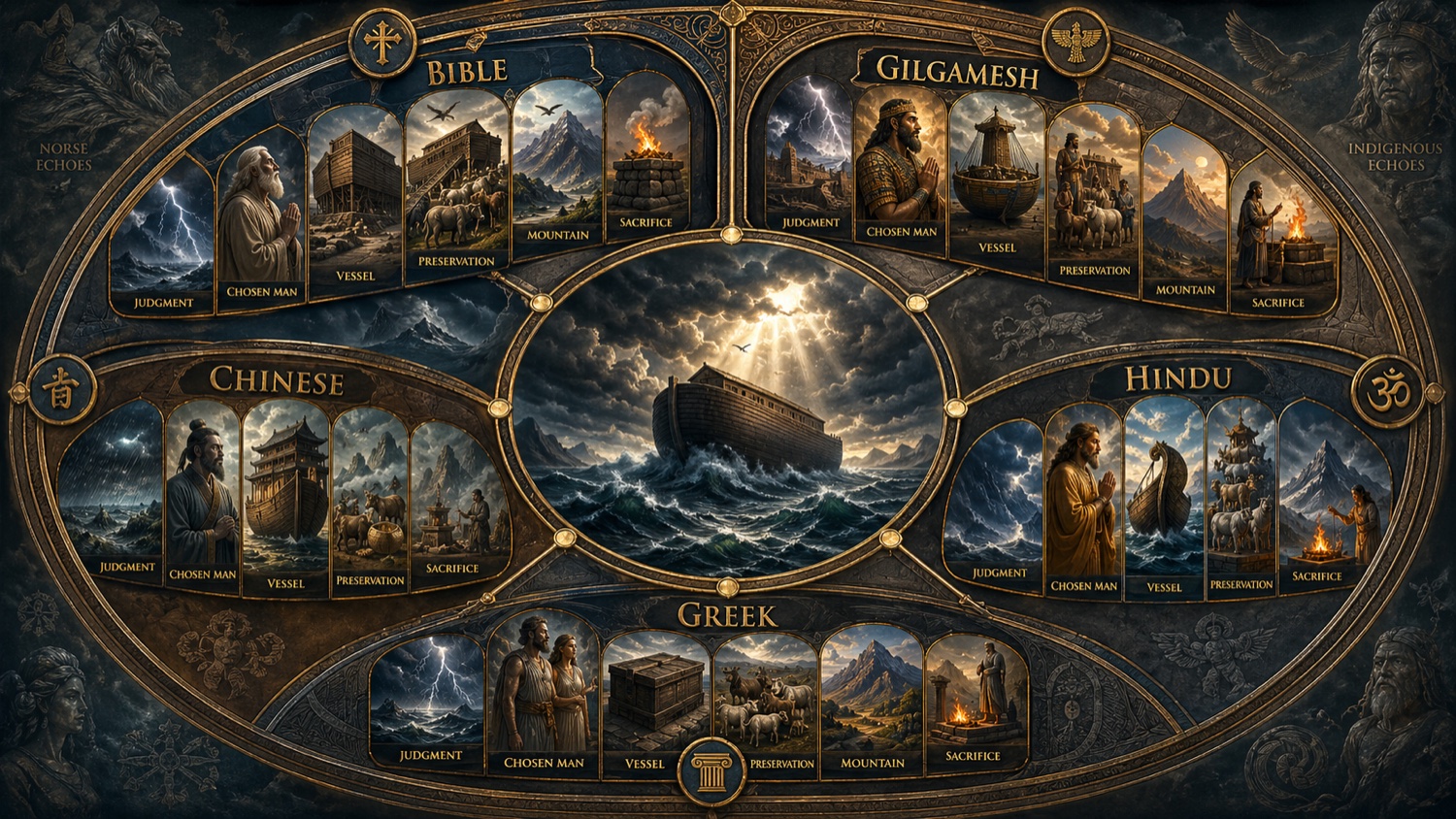
The standard secular explanation, that rivers flood everywhere, so flood stories are universal, fails to account for the theological and narrative specificity of these traditions. Rivers flooding locally does not produce global narratives about divine judgment, a single righteous survivor, a constructed vessel, the preservation of all species, and a post-flood covenant. The shared structure demands either massive cultural borrowing across oceans (for which there is no evidence) or a shared historical memory predating the separation of these cultures.
Here is an argument that requires no faith, only a calculator.
If 8 people survived the Flood approximately 4,500 years ago, how fast would the population need to grow to reach 8 billion today? The answer: an average annual growth rate of just 0.46%. For context, the world's growth rate through most of the 1800s was around 0.5%. Each couple needs roughly 2.3 surviving children on average, even accounting for plagues, famines, and centuries of stagnation. Nothing extraordinary. Nothing that requires explanation.
The evolutionary model has the harder math problem. If humans are 200,000 years old starting from a small population, that same 0.46% rate would produce a number with hundreds of digits, more people than atoms in the observable universe. To arrive at only 8 billion after 200,000 years, you need an average growth rate of 0.005%, meaning humanity barely grew at all for 195,000 years, then suddenly exploded in the last few thousand. The conventional model requires constant near-extinction events to keep the number suppressed.
The Genetic Bottleneck
Population geneticists have identified evidence of a severe bottleneck in human history, a point where our genetic diversity narrowed dramatically, as if humanity nearly went extinct and restarted from a tiny group. The secular explanation is the Toba supervolcano (~75,000 years ago). The biblical explanation is simpler: 8 people on a boat. Mitochondrial DNA analysis shows all living humans descend from a single woman ("Mitochondrial Eve") and Y-chromosome analysis traces all males to a single man ("Y-chromosomal Adam"). The convergence on a single ancestral pair is not debated, only the dates are.
The Sumerian King List
One of the oldest historical documents ever recovered, the Sumerian King List records a sequence of kings who ruled "before the flood" with reigns of tens of thousands of years. After the entry "the flood swept over," reign lengths drop dramatically to hundreds, then dozens of years. This mirrors the Genesis genealogies exactly: pre-Flood patriarchs live 700-900+ years; post-Flood lifespans plummet within generations. Whether taken literally or symbolically, both traditions encode the same pattern, a pre-Flood era of extraordinary longevity, a catastrophic reset, and a diminished world afterward.
If a global cataclysm submerged the antediluvian world, we should be able to find what's left of it on the seafloor. We can.
Dwarka, The City Krishna Built, Found Underwater
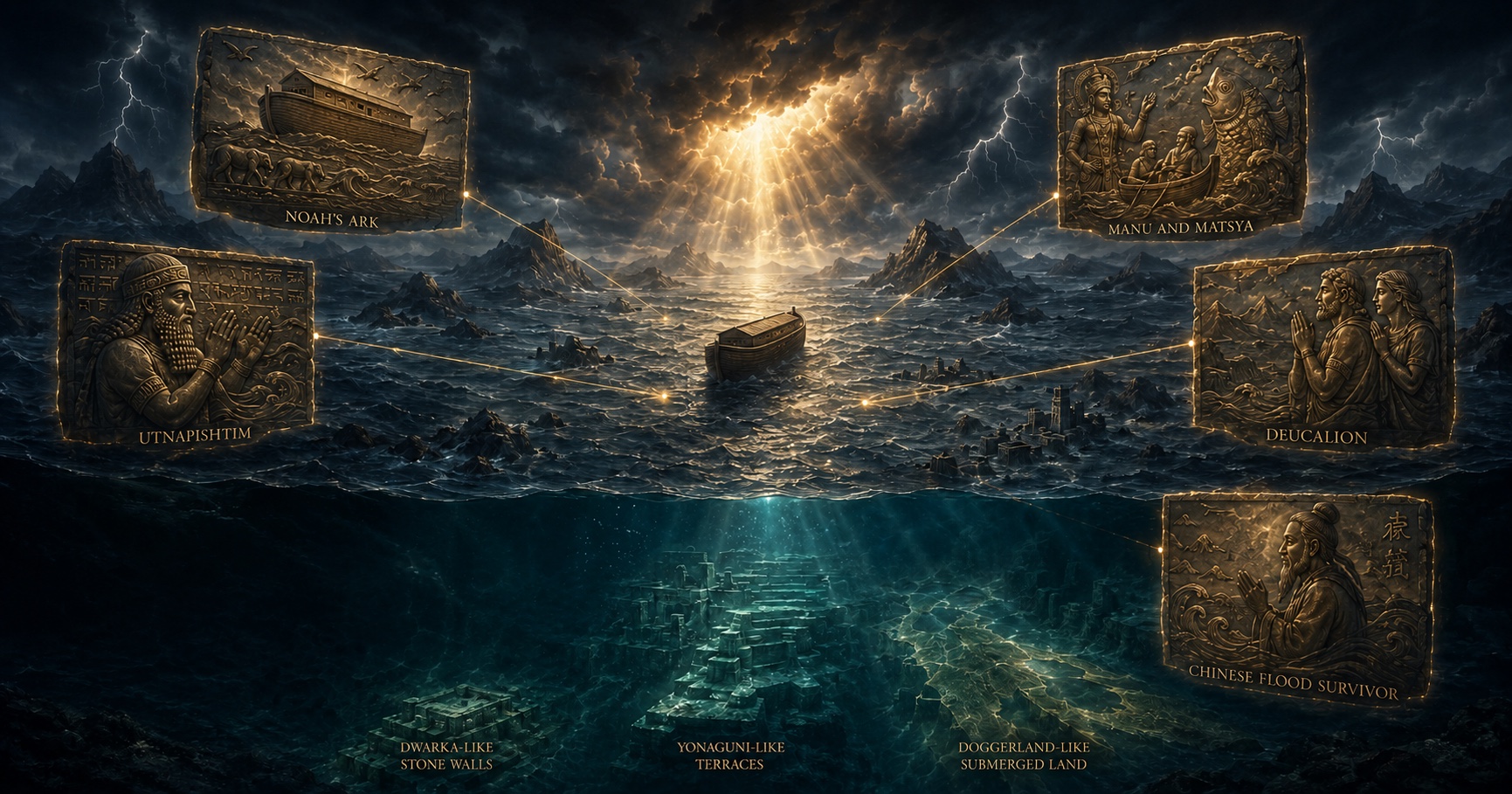
The Mahabharata describes Dwarka as the magnificent capital city built by Krishna, swallowed by the sea after Krishna's departure from earth. For thousands of years this was treated as legend. Then in 1983, the Marine Archaeology Unit of India's National Institute of Oceanography began surveying the Gulf of Khambhat off the coast of Gujarat. Between 2000 and 2002, sonar imaging revealed massive, geometrically precise stone structures on the seabed, walls, foundations, dressed blocks, and grid-pattern streets. Carbon dating of recovered wooden artifacts placed the city at roughly 7500 BCE, predating Sumer and Egypt by thousands of years. The Mahabharata named the city. It named the location. It named the cause of its destruction. Marine archaeology found it where the text said it would be.
Yonaguni, The Stepped Megalith Beneath Japan
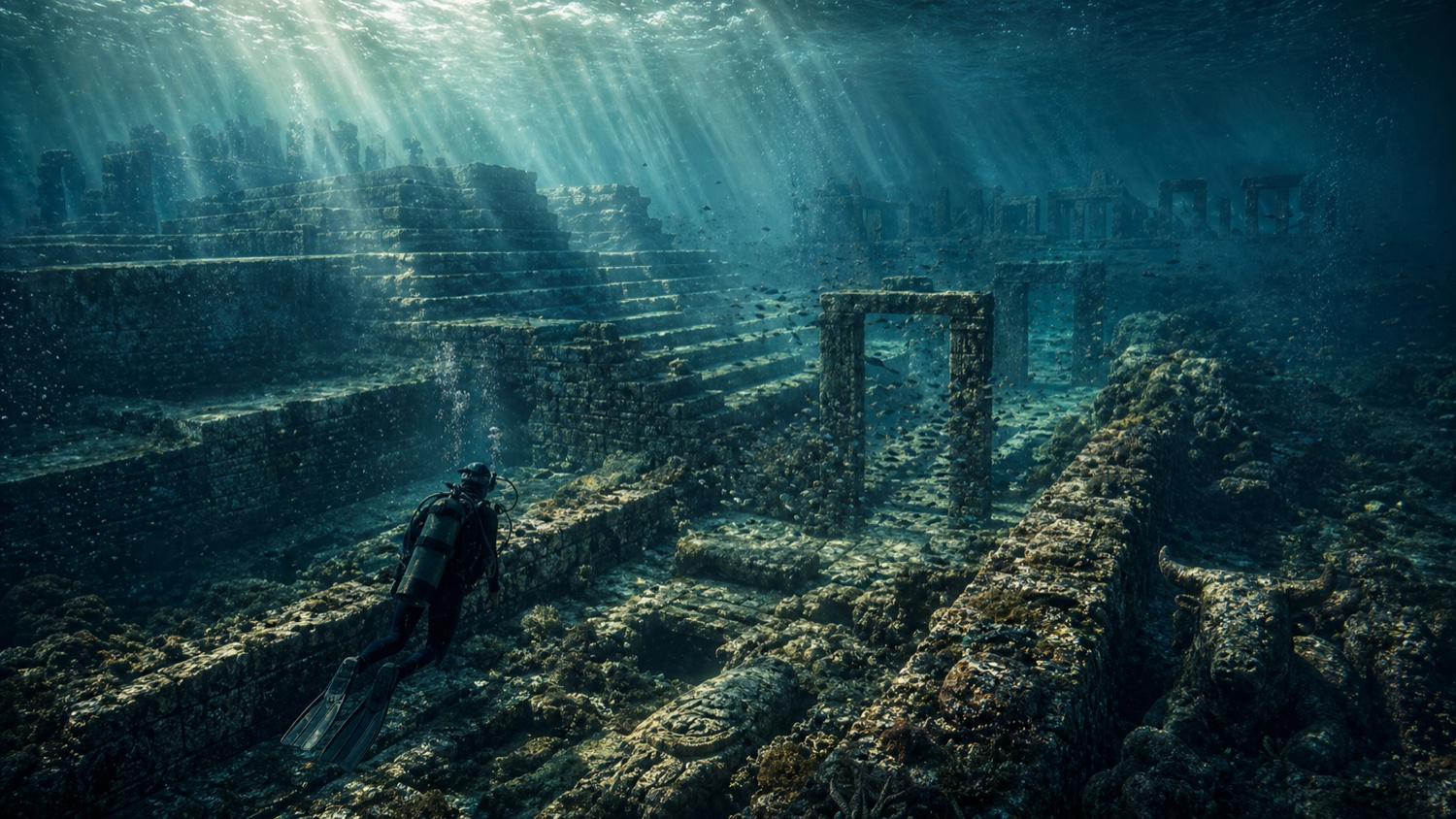
Off the coast of Yonaguni Island, southern Japan, a massive stepped stone structure sits 25 meters underwater, terraced platforms, right-angle corners, what appear to be stairways and a central pyramid-like formation. Geologist Masaaki Kimura of the University of the Ryukyus has documented the site for over two decades and considers it man-made. The dating problem is decisive: the structure has been continuously submerged for at least 10,000 years, since the end of the last Ice Age, predating every officially recognized civilization. Whoever cut these stones was building monumental architecture before "history" was supposed to begin.
Doggerland, Europe's Drowned Continent
Beneath the North Sea between Britain and Denmark lies Doggerland, a now-submerged landmass that was once dry, populated, and inhabited. Trawlers regularly drag up worked flint tools, mammoth bones, and human artifacts from its seabed. The land was progressively drowned by rising waters at the end of the last Ice Age, geologists place its final submersion around 6500–6200 BCE, possibly accelerated by the catastrophic Storegga underwater landslide and tsunami. Whatever Doggerland was, it ended exactly the way Genesis says the antediluvian world ended: by water rising and never receding.
Three continents. Three different traditions. Three submerged sites, Indian, Pacific, European, all consistent with the same global event the Bible records and every civilization remembers. The Flood didn't just kill people. It swallowed cities.
Chapter Five
If the post-Babel dispersion carried fragments of the original story eastward into the Indus Valley, we should expect to find not just flood narratives and divine-human unions, but echoes of God's own character, refracted through centuries of oral tradition into forms that are recognizable but distorted. The Hindu Trimurti, Brahma the Creator, Vishnu the Preserver, Shiva the Destroyer, is exactly that kind of echo.
The Bible describes one God who creates, sustains, and judges. In Hindu theology, these three functions were separated into three distinct deities. But look at what happens when you examine each one against the biblical source material.
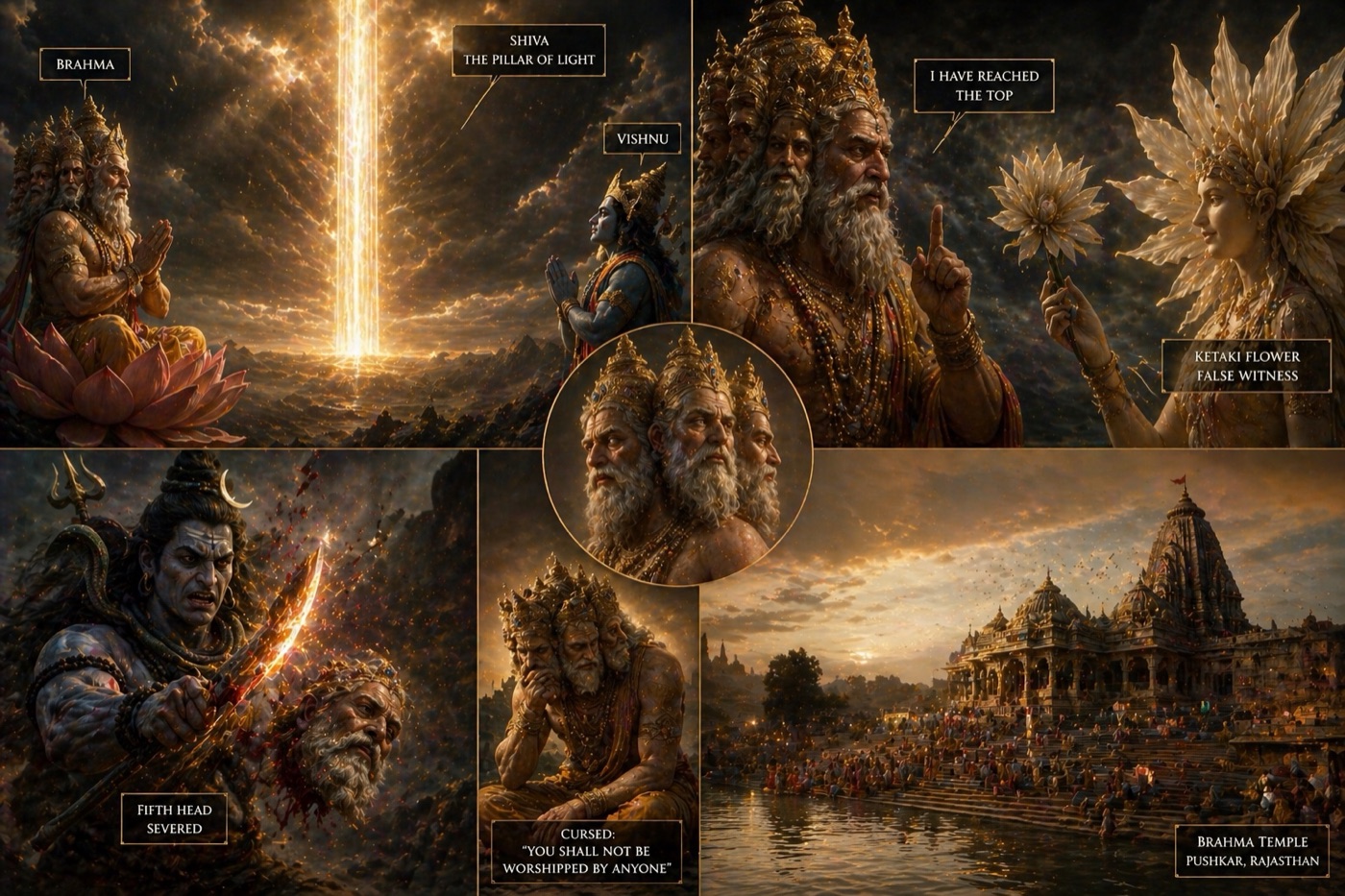
Brahma is the creator god of Hinduism. And yet, in a detail that should stop every reader, Brahma is almost never worshipped. There are hardly any temples dedicated to him in all of India. The Brahma Temple in Pushkar, Rajasthan, is one of the very few. Why would the Creator of the universe be denied worship?
The Hindu scriptures give a remarkable answer. According to the Shiva Purana, Brahma lied. When Shiva appeared as a massive pillar of light and challenged Brahma and Vishnu to find its end, Vishnu honestly admitted he could not. But Brahma lied, he claimed he had reached the top, and enlisted the Ketaki flower as a false witness. Shiva, enraged by the deception, cursed Brahma: "You shall not be worshipped by anyone." His fifth head, the one from which the lie was spoken, was severed.
The Biblical Parallel
A powerful being, originally in a position of creative authority, commits the sin of deception and is punished with permanent diminishment. He is not destroyed, but he is stripped of honor, cut off from worship, and made subordinate. Compare this to the biblical narrative: Satan, originally Lucifer ("light-bearer"), was a high-ranking angelic being who fell through pride and deception. He is not annihilated, but he is cast down, stripped of his position, and cursed. The structural parallel is precise: a being of divine origin, punished specifically for lying, permanently removed from the place of honor he once held.
Even more striking: Brahma became infatuated with his own creation, Shatarupa, and pursued her obsessively, growing a fifth head to follow her in every direction. Shiva condemned this as lust toward what Brahma himself had made. In Genesis, the Watchers likewise became infatuated with human women, beings of a lower order than themselves, and their pursuit of them is described as a violation of the created order. In both traditions, a divine being's downfall begins with improper desire for a lesser creation.
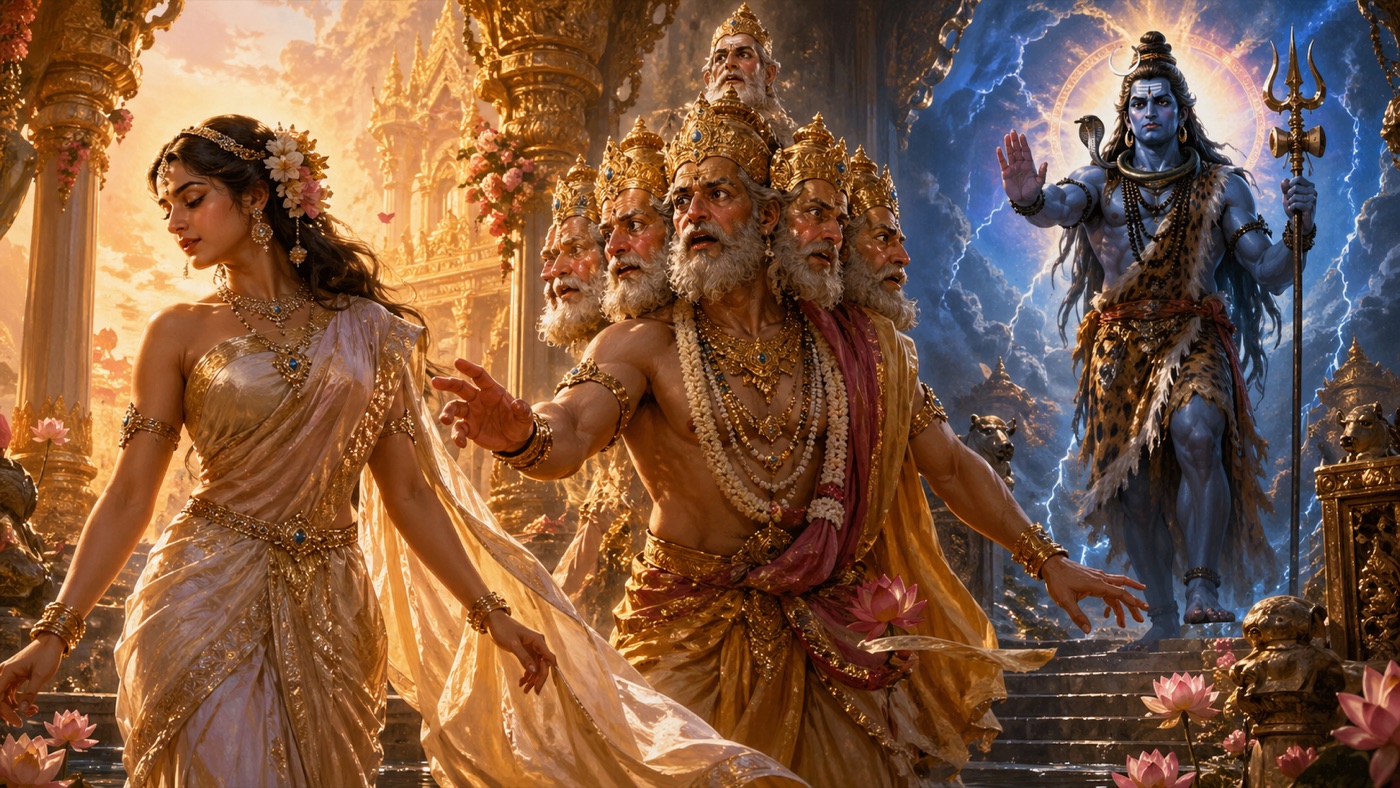
Vishnu is the Preserver, the god who descends to earth in times of crisis to restore order. He does this through ten incarnations called the Dashavatara. And his very first avatar is the most biblical parallel in all of Hinduism.
Matsya, the Fish Avatar. Vishnu descends in the form of a fish to warn Manu (the first man) of an approaching flood that will destroy all life on earth. He instructs Manu to build a boat, to gather the seeds of all living creatures, and to preserve the seven great sages. When the flood comes, Matsya guides the boat through the waters. Manu ties the vessel to the fish's horn using a great serpent as rope. The boat comes to rest on the peaks of the Himalayas, the highest ground, as the waters recede.
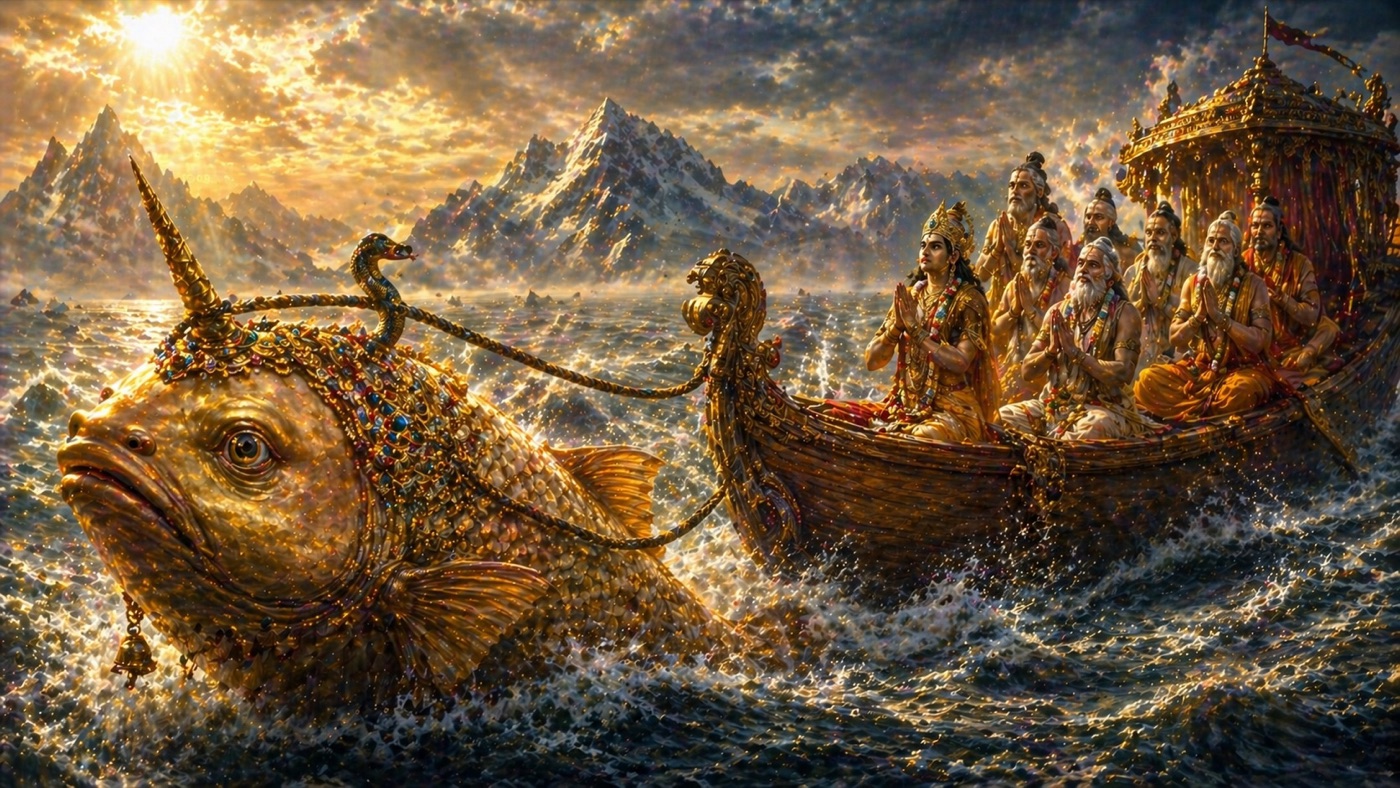
The word "Manu" itself deserves attention. Manu is the progenitor of all humanity in Hindu tradition, the name from which the Sanskrit word manushya ("human") derives. Compare this to the Hebrew tradition where humanity descends from one man through Noah, or the English word "man" itself, which some etymologists trace through Germanic roots to the same Proto-Indo-European source as "Manu." The linguistic thread is suggestive: a single ancestral figure whose name became the word for "human" across multiple language families that diverged after... Babel.
Vishnu's role as Preserver maps directly onto a biblical attribute of God: "The Lord preserves the faithful" (Psalm 31:23). The difference is that the Bible keeps this as an attribute of the one God, while the post-Babel Indian tradition separated it into a distinct deity.
This parallel is so precise it is difficult to attribute to coincidence.
Vishnu's tenth and final avatar, the one that has not yet come, is Kalki. He is prophesied to appear at the end of the Kali Yuga, the current age of darkness and moral decay. Here is how the Hindu scriptures describe him:
"Lord Kalki, the Lord of the universe, will mount His swift white horse Devadatta and, sword in hand, travel over the earth... He will kill by the millions those thieves who have dared dress as kings."
Srimad-Bhagavatam 12.2.19–20Now read the Christian prophecy written centuries earlier:
"Then I saw heaven opened, and there was a white horse. Its rider is called Faithful and True, and in righteousness he judges and makes war... From his mouth comes a sharp sword with which to strike down the nations."
Revelation 19:11–15A rider on a white horse. A sword in his hand. Coming at the end of the age of darkness. Destroying the wicked. Establishing an age of righteousness. The descriptions are not loosely similar, they are structurally identical, detail for detail.
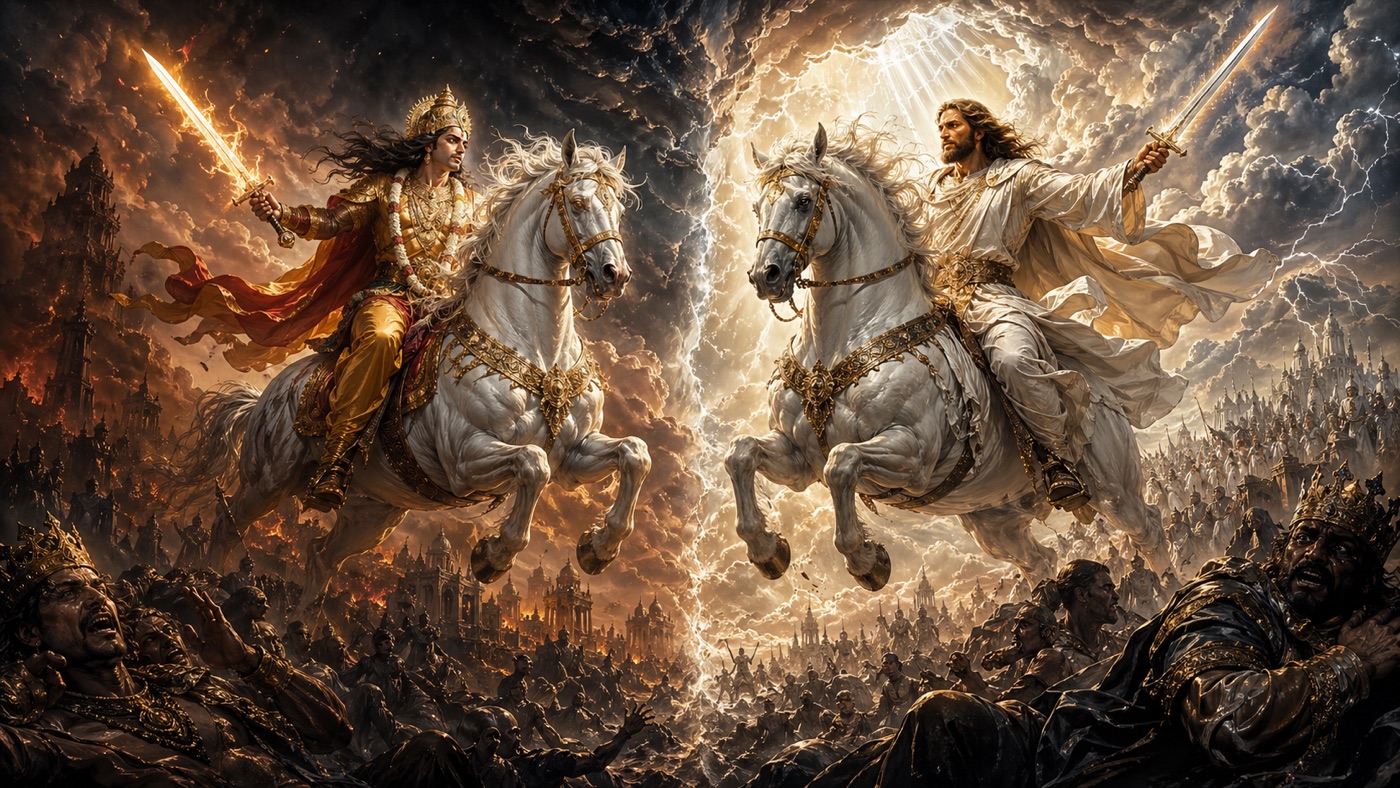
Here is the question this raises: either John of Patmos (writing Revelation around 95 AD) borrowed from Hindu prophecy, or the Hindu prophecy preserved a fragment of the same revelation that John received, carried east from Babel through oral tradition, and encoded in Sanskrit instead of Greek. Given that the Matsya flood narrative already demonstrates Hindu scripture preserving biblical events, the second explanation is not speculation, it is the established pattern.
Shiva is the Destroyer, but in Hindu theology, destruction is not evil. It is necessary dissolution, the clearing away of the old to make way for the new. Shiva's cosmic dance, the Tandava, symbolizes the destruction of the universe at the end of each cycle.
The Bible describes this same attribute in God: "I form the light and create darkness, I bring prosperity and create disaster; I, the Lord, do all these things" (Isaiah 45:7). God is not only Creator and Preserver, He is also Judge and Destroyer. The Flood was divine destruction. The plagues on Egypt were divine destruction. The prophesied end of the age is divine destruction. The Bible keeps all three functions in one God. The post-Babel traditions separated them.
Shiva also serves as the one who holds other divine beings accountable, he punished Brahma for lying, he cuts down demons, he enforces cosmic law. In the biblical framework, this is God's role as Judge: the one before whom even angels are held accountable. The Watchers learned this when their petition was denied. Brahma learned it when his fifth head was severed.
The Trimurti is not a rival theology. It is a fragmented memory of the same God, Creator, Preserver, Judge, carried east from Babel and gradually separated into three faces because the people who carried the memory lost the understanding that all three belong to One.
Chapter Six
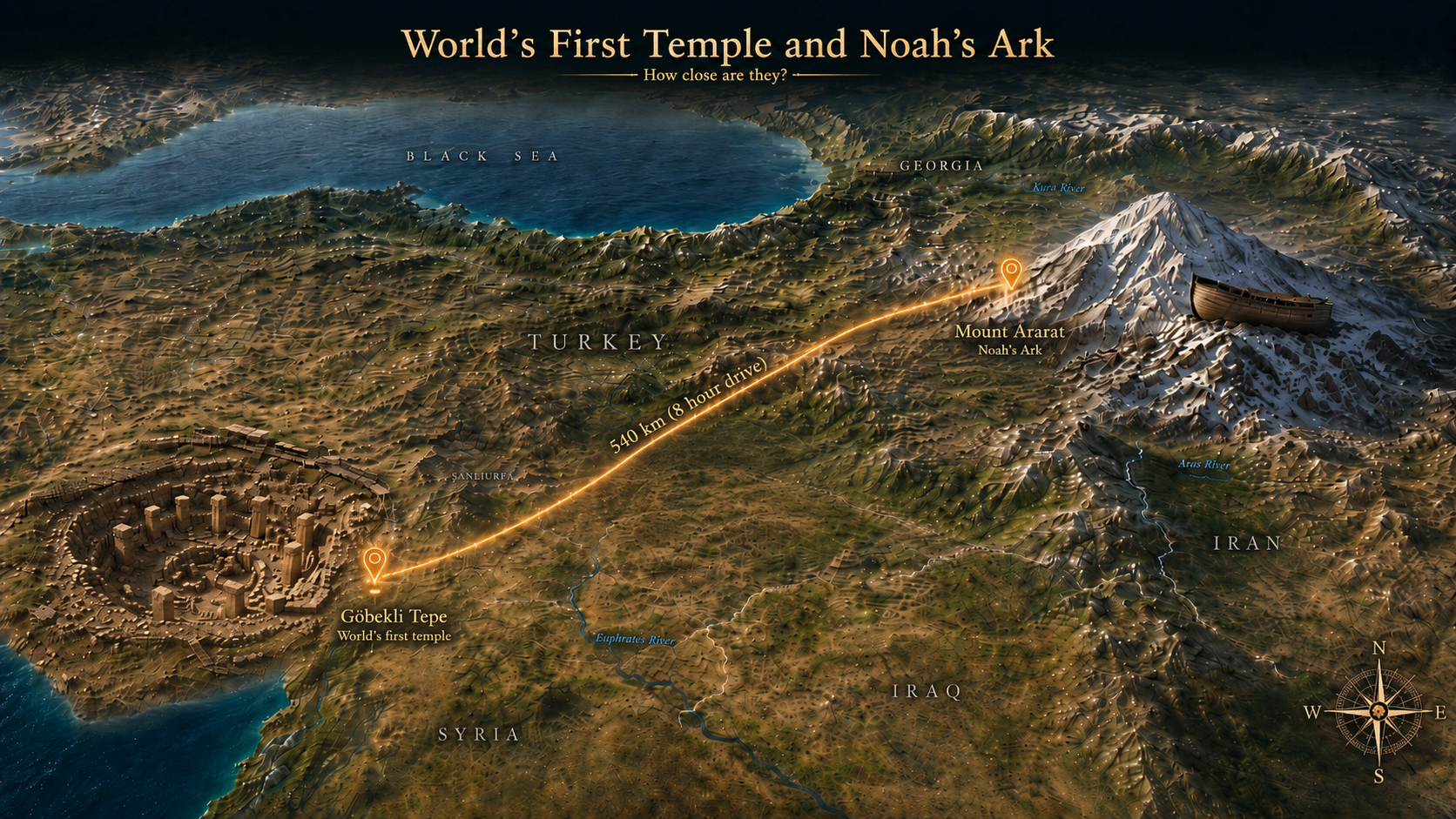
Follow the map. It tells a story that no one fabricated.
Noah's Ark lands on Mount Ararat, eastern Turkey. Now ask the simplest geographic question: if you survived a global catastrophe and landed on a mountain in eastern Turkey, where would you go?
Southeast. Downhill. Following river systems. Toward the most fertile, arable flatland in the region.
That is the Fertile Crescent. That is the plain of Shinar. That is Sumer, southern Iraq.
"As people moved eastward, they found a plain in Shinar and settled there."
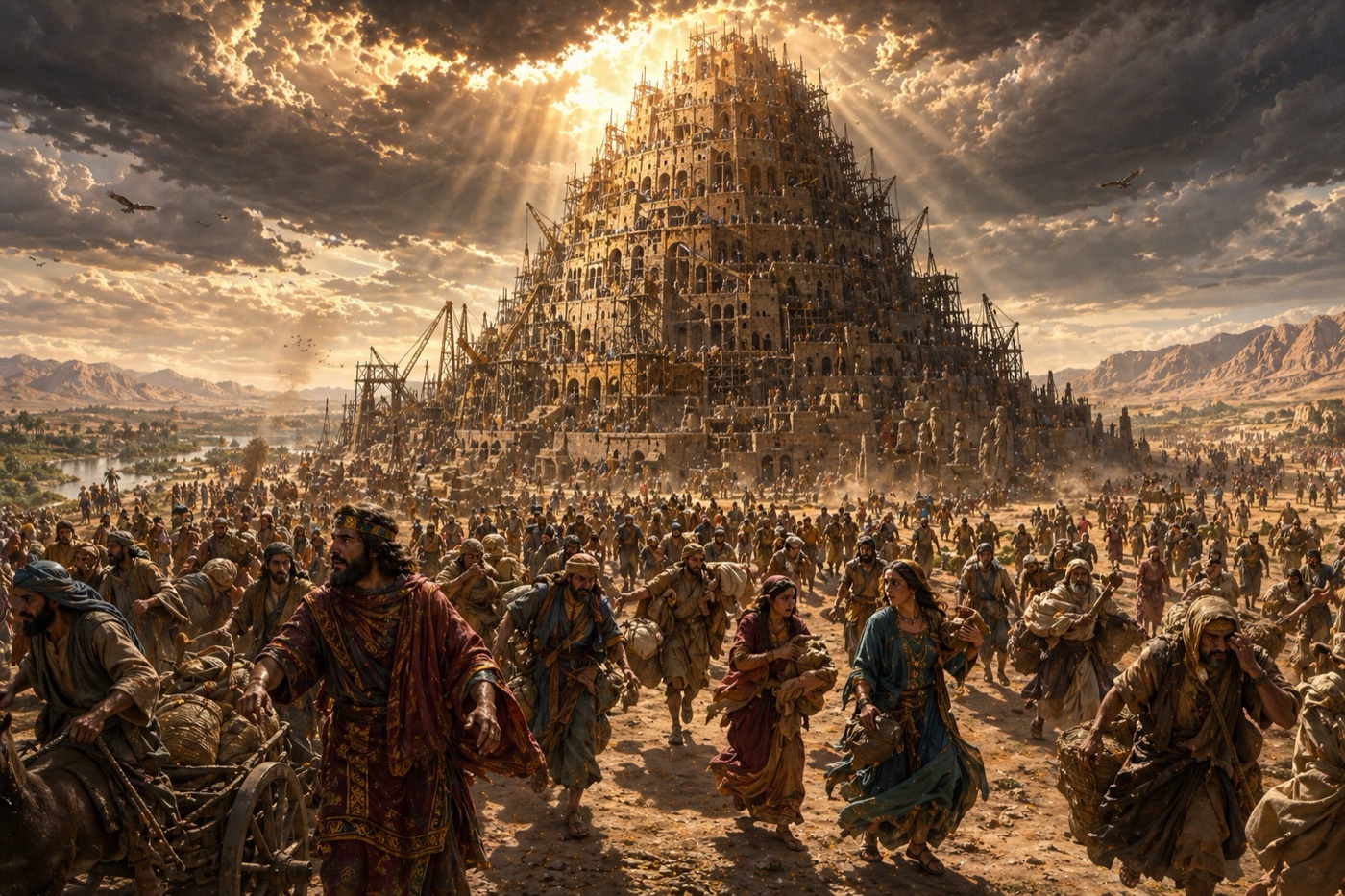
Genesis 11:2At Babel, on the plain of Shinar, humanity is unified, one language, one people, building a tower. God confuses their languages. They scatter. And Genesis 10, the Table of Nations, becomes a dispersion map:
The Semitic peoples, Hebrews, Arameans, Assyrians, Arabs. They stayed closest to the original settlement, in the Tigris-Euphrates region and the Levant. From this line, Abraham would later be called out of Ur.
Cush (Ethiopia/Sudan). Mizraim (Egypt). Put (Libya). Canaan (Levant coast). This puts the founding of Egyptian civilization after Babel, and explains how the earliest Egyptians could have carried pre-Flood building knowledge from the unified Babel community into the Nile Valley.
Anatolia (Turkey), the Caucasus, Europe, and eventually further. The Greek, Celtic, Germanic, and Slavic peoples. Japheth's son Javan is the ancestor of the Ionians (Greeks). Gomer is associated with the Cimmerians. Madai with the Medes (Persia/Iran).
The 70 Nations, Jewish Tradition
Jewish tradition counts exactly 70 nations in the Table of Nations (Genesis 10), corresponding to 70 languages created at Babel. This number carries deep significance across all three Abrahamic faiths. In Judaism, it became the basis for the concept that God assigned a guardian angel to each of the 70 nations, while retaining Israel as His direct portion (Deuteronomy 32:8-9, as preserved in the Dead Sea Scrolls). The Septuagint, the Greek translation of the Hebrew Bible, completed around 250 BCE, translates this passage as God dividing the nations "according to the number of the angels of God." Seventy elders accompanied Moses up Sinai. Jesus sent out 70 disciples. The Sanhedrin had 70 members. The number is not arbitrary; it is the Bible's count of how many branches humanity split into when the one language became many.
If the Babel event happened, we should expect a memory of it in the records of the people who lived there, and we have it. Long before Genesis was compiled, Sumerian scribes were already writing about the same event in cuneiform.
Enmerkar and the Lord of Aratta, The Sumerian Babel Memory
Among the oldest surviving works of human literature is a Sumerian text called "Enmerkar and the Lord of Aratta," preserved on cuneiform tablets dating to roughly 2000 BCE, and almost certainly composed earlier. Embedded in it is one of the most arresting passages in ancient literature:
"Once upon a time… the whole universe, the people in unison, to Enlil in one tongue gave praise… Enki, the lord of abundance… changed the speech in their mouths, brought contention into it, into the speech of man that until then had been one."
A unified humanity. One language. A god intervenes. Speech is divided. Read that passage to anyone unfamiliar with both texts and ask which one is from Genesis. The Sumerians, the people whose city of Eridu is the closest archaeological candidate for the location of Babel itself, recorded the same event the Bible records, in the same place, with the same outcome. The Bible did not invent the Babel story. The Bible preserved it. The Sumerians preserved it too, and they were closer to it.
The Pre-Flood / Post-Flood Pattern in Sumerian Records
The Sumerian King List, already cited above for its pre-Flood lifespans, records civilization itself as something that descended from heaven and was reset by the Flood: "After kingship had descended from heaven, kingship was at Eridu… the flood swept over… after the flood had swept over, when kingship descended again from heaven, kingship was at Kish." Same pattern Genesis records. Same break-point. Same continuity. The two oldest written traditions on earth, the Hebrew Torah and the Sumerian tablets; agree on the structure of human history's earliest centuries. They differ only in theology: the Sumerians attributed the events to Anu, Enlil, and Enki. The Hebrews attributed them to one God. The events themselves are the same.
This is not a story Israel borrowed from Sumer. It is a story both peoples remembered, because both descend from the same population that lived through it.
Now overlay this map onto the earliest civilization clusters that archaeology identifies: Sumer (southern Iraq), Egypt (Nile Valley), Indus Valley (Harappa, Mohenjo-daro), China (Yellow River), Anatolia (Turkey/Greece). Every one sits along a natural migration corridor from the Mesopotamian heartland. Every one has a flood narrative. Every one remembers divine beings who gave knowledge to humans. Every one experienced a "golden age" followed by decline.
The Bible doesn't track the eastern migrations after Babel, its camera follows Shem's line toward Abraham. But the branches that went east carried the same memories. The branch that reached the Indus Valley remembered the Flood as Manu's story and the divine-human unions as the Devas and the Pandavas. The branch that reached Greece remembered them as the Titans, the demigods, and the flood of Deucalion. Same events. Different languages. Gradually diverging retellings.
The Linguistic Evidence
The world's languages cluster into families that linguists can trace to common ancestors. The Indo-European family alone connects Sanskrit, Greek, Latin, Persian, Celtic, Germanic, and Slavic languages, all descended from a single proto-language whose speakers originated, by scholarly consensus, somewhere near the Caucasus or Anatolia. This is precisely the region between Ararat and Babel. The linguistic evidence independently confirms a dispersion pattern radiating outward from the same geographic zone the Bible identifies.
Chapter Seven
The Book of Enoch names specific Watchers and what they taught. Azazel taught metallurgy, weapons, and cosmetics. Araqiel taught geomancy, reading the signs of the earth. Shemhazai taught enchantments and herbalism. Baraqijal taught astrology. Kokabiel taught the constellations.
Now look at what every ancient civilization attributes to its "gods":
The Anunnaki taught humanity agriculture, irrigation, writing (cuneiform), mathematics, astronomy, law, and city planning. Civilization appeared in Sumer not gradually but suddenly, fully formed writing, sophisticated mathematics, complex governance, in what historians call the "Sumerian Problem."
Thoth, the god of wisdom, gave humanity writing (hieroglyphics), medicine, astronomy, and mathematics. The precision of the Great Pyramid, built in the earliest dynasties, implies knowledge that later Egyptians could not reproduce.
Prometheus stole fire, divine knowledge, from the gods and gave it to humans. He was punished for it: chained to a rock for eternity. The Watchers were punished too: chained in darkness until the day of judgment. Both traditions encode the same moral: this knowledge came at a cost, and the one who transmitted it paid dearly.
The Devas and Rishis transmitted the Vedas, sacred knowledge encompassing astronomy, mathematics, medicine, language, philosophy, and ritual. Indra, king of the Devas, is described as having taught sacred hymns to ancient sages. The Vedic tradition explicitly credits its knowledge to divine transmission, not human discovery.
Every civilization tells the same story: superhuman beings gave us knowledge we shouldn't have had yet, and there was a terrible price. The Bible calls them Watchers and says they were imprisoned for it. The Greeks called it Prometheus and said he was chained for it. The Sumerians called them Anunnaki and said they were assigned to the underworld. The language differs. The structure is identical.
The Pyramid Texts, carved into the inner walls of the pyramid of Unas at Saqqara around 2400 BCE, are the oldest religious writings on earth. They predate the Hebrew Torah by nearly a thousand years. Buried in their imagery is a creation account that should not exist if Egyptian theology developed in isolation:
Atum and the Primordial Waters
The Pyramid Texts describe a primeval state called Nu or Nun, a vast, dark, watery chaos that covered everything before the world began. Out of this watery deep arose Atum, the first deity, who stood on a single mound emerging from the waters and brought forth life. Compare to Genesis 1:2: "The earth was without form, and void; and darkness was on the face of the deep. And the Spirit of God moved upon the face of the waters." Same imagery. Same structure. Dark water, then light, then a single mound of dry land emerging. The two oldest written religious traditions on earth start the same way.
Atum and Adam, A Name Echo Across Languages
The Egyptian word Atum and the Hebrew word Adam share the same consonantal root structure (ʾ-t/d-m). Both names refer to the first being. Both are associated with the breath of life, with creation from earth, with primordial origins. Most linguists treat the parallel as coincidence, but the cluster of agreements (creation from a watery chaos, a single first being, emergence onto land) is hard to dismiss. If the post-Babel dispersion carried the original memory into Egypt, this is exactly the kind of fingerprint we'd expect: the names slightly distorted, the structure preserved.
A Memory Older Than Egypt's Gods
The Pyramid Texts also contain references to a primordial flood, to a "first time" (zep tepi) when the gods walked the earth, and to a fall from that golden age into the world we now inhabit. Egyptian theology is older than the Pyramid Texts, but the Pyramid Texts are the earliest written form of it, and what they preserve is the same skeletal narrative the Bible records: a creator God, a primordial paradise, a corruption, a flood, and a diminished world afterward. Two ancient civilizations writing in completely different languages, on opposite ends of the same migration corridor, recording the same story.
Of all the forbidden knowledge the Watchers transmitted, one stands out: the constellations. The Book of Enoch specifically names Kokabiel as the Watcher who taught humans "the signs of the stars" and Baraqijal as the one who taught astrology. But here is the question no one asks: if God condemned this knowledge as forbidden, why did He Himself set the stars in patterns and name them?
"He determines the number of the stars and calls them each by name."
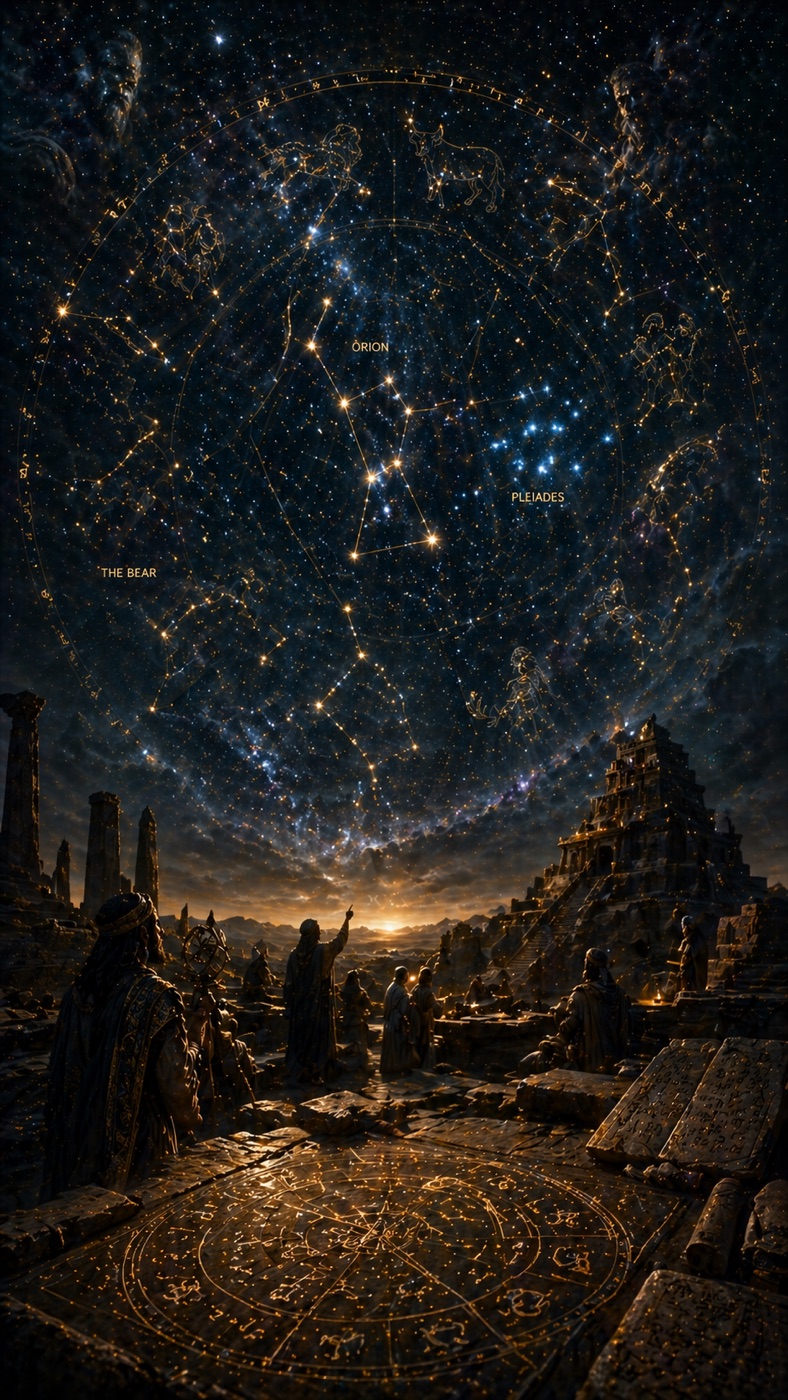
Psalm 147:4The Bible names specific constellations: Orion, the Pleiades, and the Bear (Job 38:31-32). God asks Job: "Can you bind the chains of the Pleiades? Can you loosen Orion's belt? Can you bring forth the Mazzaroth in their seasons?" The Hebrew word Mazzaroth refers to the zodiacal constellations, the twelve signs. God is not condemning the constellations themselves. He is claiming authorship of them.
This distinction matters: the constellations were God's original communication, and the Watchers corrupted them into fortune-telling. What was meant to tell a story was twisted into a system of divination. Astrology as practiced today, predicting personal futures from star positions, is the corrupted version. The original zodiac may have told a very different story.
The Gospel in the Stars
Multiple scholars, from E.W. Bullinger in the 19th century to D. James Kennedy and Chuck Missler, have argued that the original zodiac, before it was corrupted, told the story of redemption. Read in order: Virgo (the virgin) bears a child. Libra (the scales) represents judgment and the price of redemption. Scorpio represents the enemy who strikes. Sagittarius is the archer-warrior who defeats the enemy. Capricorn is the sacrificial goat. Aquarius pours out living water. Pisces represents the people gathered. Aries is the ram, the substitute sacrifice. Taurus is the bull of judgment returning. Gemini represents the dual nature (God and man). Cancer is the fold; the place of safety. Leo the lion, the Lion of Judah, triumphs as king. From virgin birth to triumphant king. Every ancient civilization had these twelve signs. The question is: who wrote them first?
This explains a paradox that has puzzled scholars: why do the same twelve zodiac signs appear across Babylonian, Egyptian, Greek, Hindu (Rashi), Chinese, and Mesoamerican cultures? The standard explanation, cultural diffusion from Babylon, fails to account for zodiacal systems in civilizations that had no contact with Babylon. The Babel explanation works: everyone left the same city carrying the same sky-knowledge, and the twelve signs diverged along with the languages.
The Watchers didn't invent the stars. They stole them. They took God's original sky-story and taught humanity to use it for self-centered divination instead of reading the message it was designed to carry. Every horoscope column in every newspaper is a faint, corrupted echo of a story that was never about you, it was about the One who was coming.
Every culture inherited the sky. The Babylonian zodiac, the Egyptian decans, the Greek constellations, the Hindu rashis, the Chinese twelve animals, the same twelvefold pattern recurs across continents that had no contact with each other. This is the Babel-dispersed sky-knowledge, fragmented into different languages but recognisably the same map.
Vedic Jyotish is one of the most sophisticated of these inherited systems: planetary periods (dashas), lunar mansions (nakshatras), birth charts of remarkable mathematical depth. Babylonian astrology shaped Western horoscopy. The Mayan codices tracked Venus across centuries. None of these traditions are nothing. Each one is a fragment of something that was once whole, and each one operates at the resolution the inherited sky was given to operate at: seasons, cycles, characters, generations.
The Bible itself affirms this purpose. Genesis 1:14 says God set the lights "for signs and for seasons, for days and years." That is what every inherited sky-system across every civilization preserves, and preserves well. The sky was authored to mark times. It was never given to name a person.
The thing that can name a person is what the Bible calls prophecy. And what prophecy does, in resolution and specificity, is the marvel that should arrest every reader, regardless of tradition.
Every inherited sky-tradition, Vedic, Babylonian, Egyptian, Greek, Chinese, speaks in tendencies, periods, characters, and seasons. "A time of difficulty is approaching." "Saturn's transit indicates challenges in relationships this year." "This year favours new beginnings." Statements like these describe roughly one-twelfth of humanity at any moment. They cannot be proven wrong, because "challenges" can be a delay, a disagreement, a mood. This is not a flaw in any particular tradition. It is the resolution the inherited sky was meant to operate at.
Biblical prophecy operates at a completely different resolution, not because the sky-traditions failed, but because prophecy is doing something the sky was never given to do.
Micah named the city, Bethlehem, seven hundred years before Jesus was born there. Not "a small town" or "somewhere in Judea." Bethlehem. Zechariah named the price, thirty pieces of silver, five hundred years before Judas received exactly that amount. Daniel calculated the exact year the Messiah would arrive, using a 483-year timeline from the decree to rebuild Jerusalem, and the math lands precisely on the year Jesus entered Jerusalem on a donkey, fulfilling Zechariah 9:9 to the day.
No sky-tradition in any culture, Vedic, Babylonian, Egyptian, Greek, or Chinese, has ever produced a prediction at this level. Not naming a city centuries in advance. Not naming a price. Not calculating a year. This is not because the inherited sky-systems are empty. It is because the sky was authored to mark seasons, and prophecy is the part of the sky-story that was kept whole enough to name a person.
The Probability Test
Mathematician Peter Stoner calculated that the probability of any one person fulfilling just 8 of the major messianic prophecies by coincidence is 1 in 10 to the 17th power, that is 1 in 100,000,000,000,000,000. To visualize: cover the entire state of Texas two feet deep in silver coins, mark one coin, blindfold someone, and have them pick the marked coin on the first try. Jesus fulfilled not 8 but over 300 prophecies. The odds of that happening by chance are a number so large it has no meaningful analogy. This is not an inherited sky-tradition's vague "a change is coming." This is named cities, named prices, named methods of death, written centuries before the events occurred and preserved in manuscripts we can date.
Here is what this means for every reader, from every tradition. The constellations were authored. The zodiac told a story. Jyotish, the Babylonian zodiac, the Mayan codices, the Egyptian decans, all of them preserved the rhythm of the original sky-message. What prophecy preserved is the name. When the rider on the white horse comes, every tradition that has been watching the sky for millennia will have been waiting for him under different names, Kalki on Devadatta, the True White Brother, Saoshyant, the returning Faithful and True. The original sky-story was always pointing to one person. The traditions that kept the rhythm but lost the name will recognise him when the name is spoken.
This is why prophecy is verifiable, in a way no inherited sky-tradition is. Not because astrology failed. Because prophecy is the part of the sky-story that was kept whole.
Chapter Eight
Genesis 6:4 contains a detail that is easy to miss: "The Nephilim were on the earth in those days, and also afterward." The divine-human hybrid problem didn't end with the Flood. It resurfaced.
The Bible records a sustained campaign against post-Flood giant lineages across the ancient Near East. The Anakim. The Rephaim. The Emim. The Zamzummim. King Og of Bashan, whose iron bed was 13 feet long. Goliath of Gath, standing over nine feet tall, wearing serpent-like scale armor. David's mighty men killed the last of the Rephaim warriors, and one of them had six fingers on each hand and six toes on each foot.
These wars occupied Israel roughly from 1400 to 1000 BCE. The mission was specific: systematically destroy the remnants of the Nephilim bloodline in the promised land.
Now consider the Mahabharata timeline. Historians estimate the Kurukshetra War to roughly 1200–900 BCE, an almost exact overlap with the biblical period of Judges through David. The Pandavas, fathered by gods, fought a war so devastating it killed nearly every warrior on the subcontinent and ended an entire cosmic age.
What if these weren't separate events but the same global cleanup happening simultaneously on different continents?
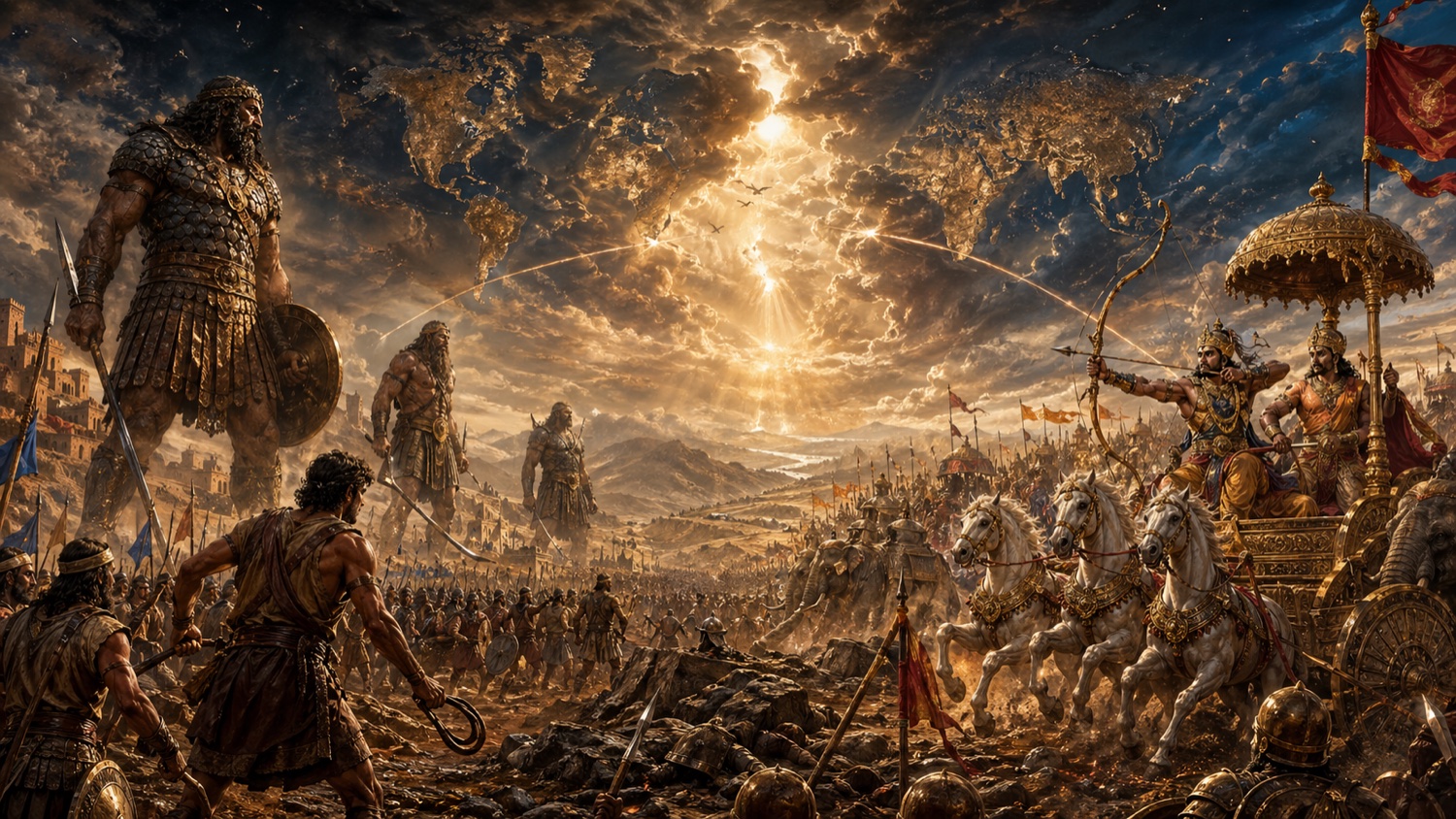
The Greek parallel reinforces this. The Trojan War, understood in Greek tradition as Zeus's plan to reduce the population of demigods on earth, is conventionally dated to approximately 1200 BCE. The same window. The same pattern: divine-fathered warriors, a catastrophic war, and the end of an age of heroes.
The Bible describes it as conquest. The Mahabharata describes it as dharmic war. The Greeks described it as the twilight of heroes. Three civilizations, three continents, the same era, the same event: the divine-human hybrids were being removed from the earth.
Chapter Nine
After Babel, every branch of humanity carried fragments of the original story. But the fragments degraded. Names changed. Details blurred. Gods multiplied. The flood became a local legend. The Watchers became a pantheon. The one Creator became many creators.
One line kept the signal clean.
God calls Abraham out of Ur, a city in southern Iraq, in the heart of Sumer, the very civilization that descended from Babel. Abraham isn't emerging from nowhere. He is being called out of the world's oldest post-Flood culture, the one closest to the original events, with the least signal degradation.
The geographic trail forms an unbroken loop:
The beginning. The garden at the convergence of rivers.
The reset. Noah's family descends from the mountain.
The dispersion. Languages confused. Nations scattered across the earth.
The covenant. One man, one family, one promise.
The preservation. Israel grows into a nation in Egypt.
The redemption. The conquest of the Nephilim remnant in the Promised Land.
The promise fulfilled. The "seed of the woman" arrives, not as a warrior-king, but as a child born in the land the Nephilim once occupied.
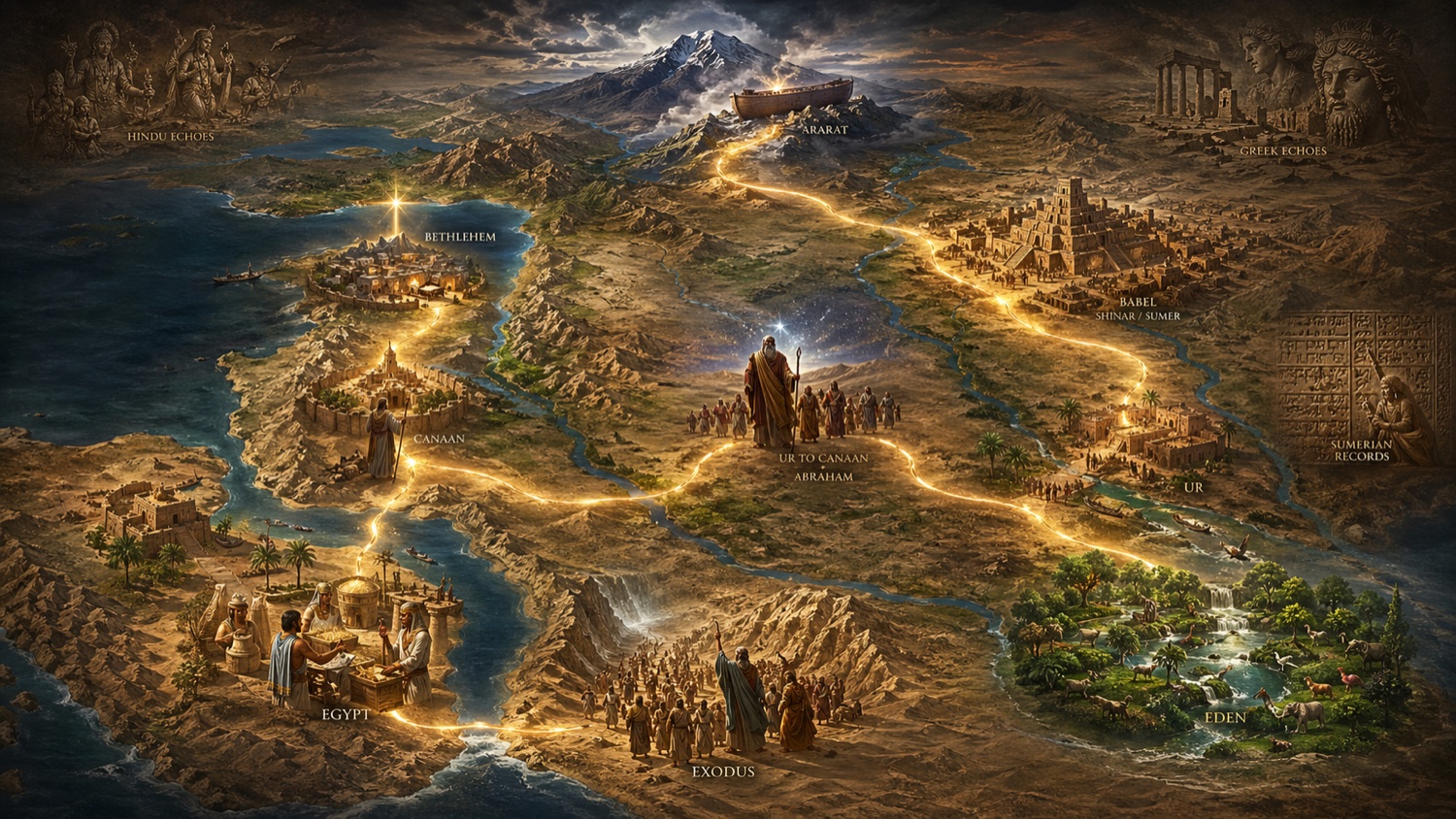
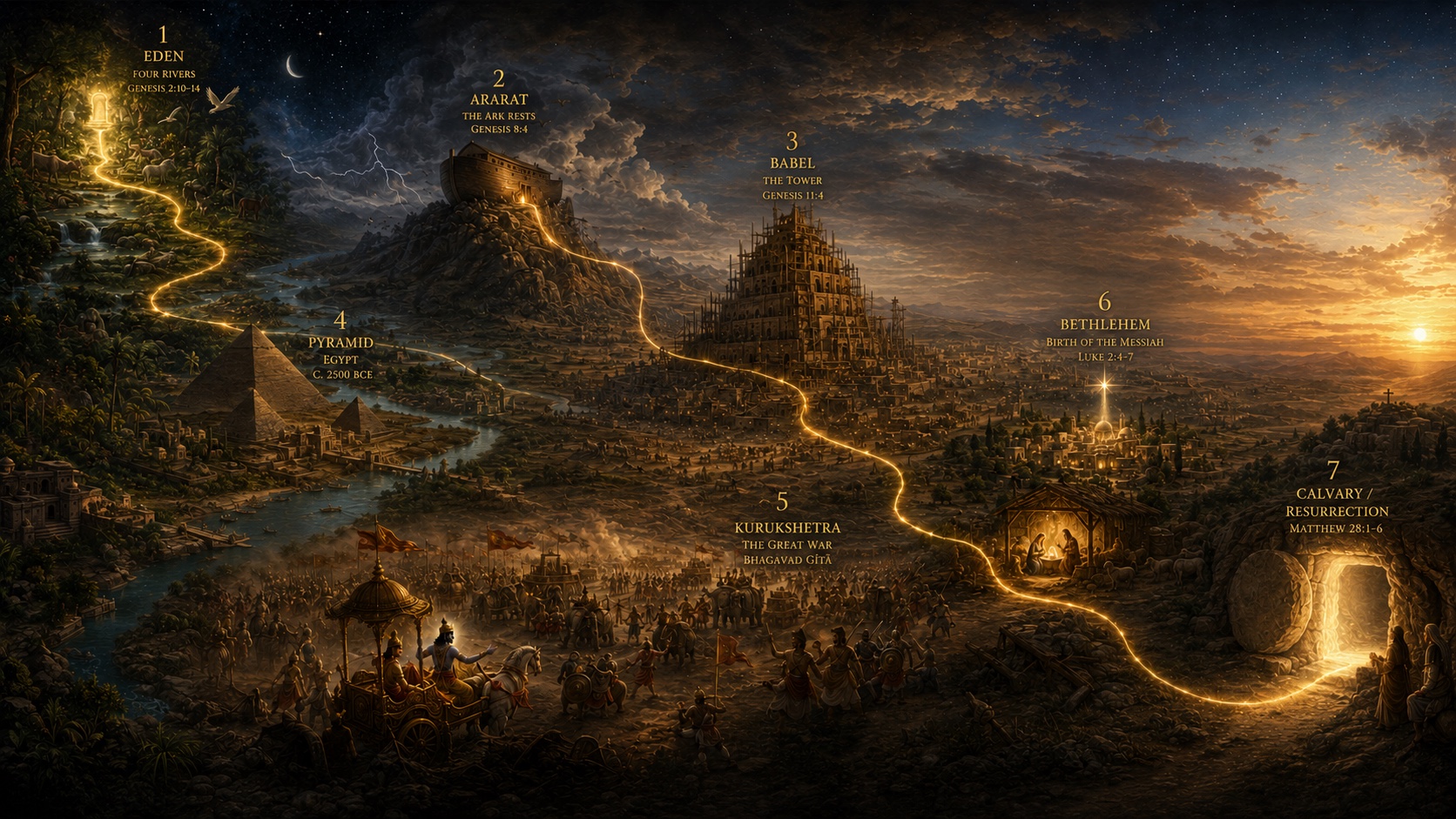
Every point on this loop corresponds to a major archaeological civilization center. Every transition is geographically plausible. The trail doesn't skip continents or require impossible migrations. It follows rivers, valleys, and natural corridors, the exact paths real people would actually walk.
This is what separates the biblical account from every other ancient tradition. The Hindu scriptures preserve fragments of the pre-Babel memory, the flood, the divine-human unions, the age-ending war, but they don't trace the why. The Greek myths remember the Titans and the demigods but can't explain why the gods fell or what the endgame is. The Sumerian records document the Anunnaki and the flood but dissolve into polytheism.
Only the Bible maintains a single narrative thread from Eden to the present: one God, one rebellion, one promise, one bloodline, one redeemer. Everything else is an echo of the same events, heard through walls, in languages that drifted further from the original with every generation after Babel.
If the Bible's account of the past is anchored by the convergence of every other tradition, the same convergence runs forward, into the end. The rider on the white horse is not the only end-times figure preserved across civilizations. He is one of five, the same return-and-renewal pattern preserved in Hindu, Mayan, Hopi, Norse, and Zoroastrian scripture, on five different continents.
Hinduism, Kalki on Devadatta
Vishnu's tenth avatar arrives at the close of the Kali Yuga, riding a white horse, sword in hand, to destroy the wicked and inaugurate a new age of righteousness. Already explored above, and identical, line by line, to Revelation 19's rider on the white horse.
Maya, The End of the Fifth Sun
The Maya tracked time in great cycles called Suns. Each Sun ends in catastrophic destruction. The first ended in jaguars devouring humanity. The second in hurricanes. The third in fire. The fourth in flood, the Maya's own memory of the Flood every civilization remembers. The Fifth Sun, the current one, is prophesied to end in earthquakes, followed by the return of Quetzalcoatl, the white-robed feathered serpent god who promised to come back from the east. When Cortés arrived in 1519, from the east, fair-skinned, bearded; the Aztec emperor Montezuma believed Quetzalcoatl had returned. The expectation was already there. It was just attached to the wrong man.
Hopi, The Ninth Sign and the Day of Purification
The Hopi of the American Southwest preserve a prophecy of nine signs that precede the end of this age. Hopi elders interpreted the eighth sign (a "house in the sky" falling, widely understood after the fact as the 1979 Skylab descent) and the ninth sign as preceding the "Day of Purification." After the purification, a true white brother returns from the east, bringing the missing piece of the sacred stone the Hopi have guarded for centuries, and a new world begins. The structural elements are precise: a series of signs, a great purification, the return of a savior figure from the east, the inauguration of a new age.
Norse, Ragnarök and the Renewed World
The Norse Ragnarök describes the final battle: the wolf Fenrir devours the sun, the serpent Jörmungandr rises from the sea, the heavens crack, and the gods themselves fall. The world is consumed by fire. But Ragnarök is not extinction, it is followed by the rising of a green new earth, the return of life, and the rule of a single righteous figure who survives the cataclysm. Compare to Revelation 20–21: a final battle, the destruction of the present world by fire, then "a new heaven and a new earth," with God Himself dwelling among His people. Same structure. Same outcome. Different names.
Zoroastrianism, Saoshyant the Final Savior
The ancient Persian religion of Zoroastrianism, founded around 1500–1000 BCE, long before the Christian era, taught the coming of Saoshyant, the final savior. He will be born of a virgin, raise the dead, conduct a final judgment, defeat the great deceiver Angra Mainyu, and inaugurate the Frashokereti, the renewal of the world. The Zoroastrian Magi who came to worship the infant Christ in Matthew 2 came because their own scriptures had told them the savior was due. The end-times structure is identical to the biblical one; and the Zoroastrians were carrying it for over a thousand years before the New Testament was written.
Five traditions. Five continents. The same end-times structure: a final corruption, a final battle, a returning rider or savior figure, the destruction of the present age, and a renewed world.
This is not coincidence and it is not borrowing. The Maya could not have read Revelation. The Hopi were not in contact with Persia. The Norse skalds were not consulting Hindu Puranas. Every branch of the post-Babel dispersion carried forward the same prophecy, because the prophecy was given before the dispersion began.
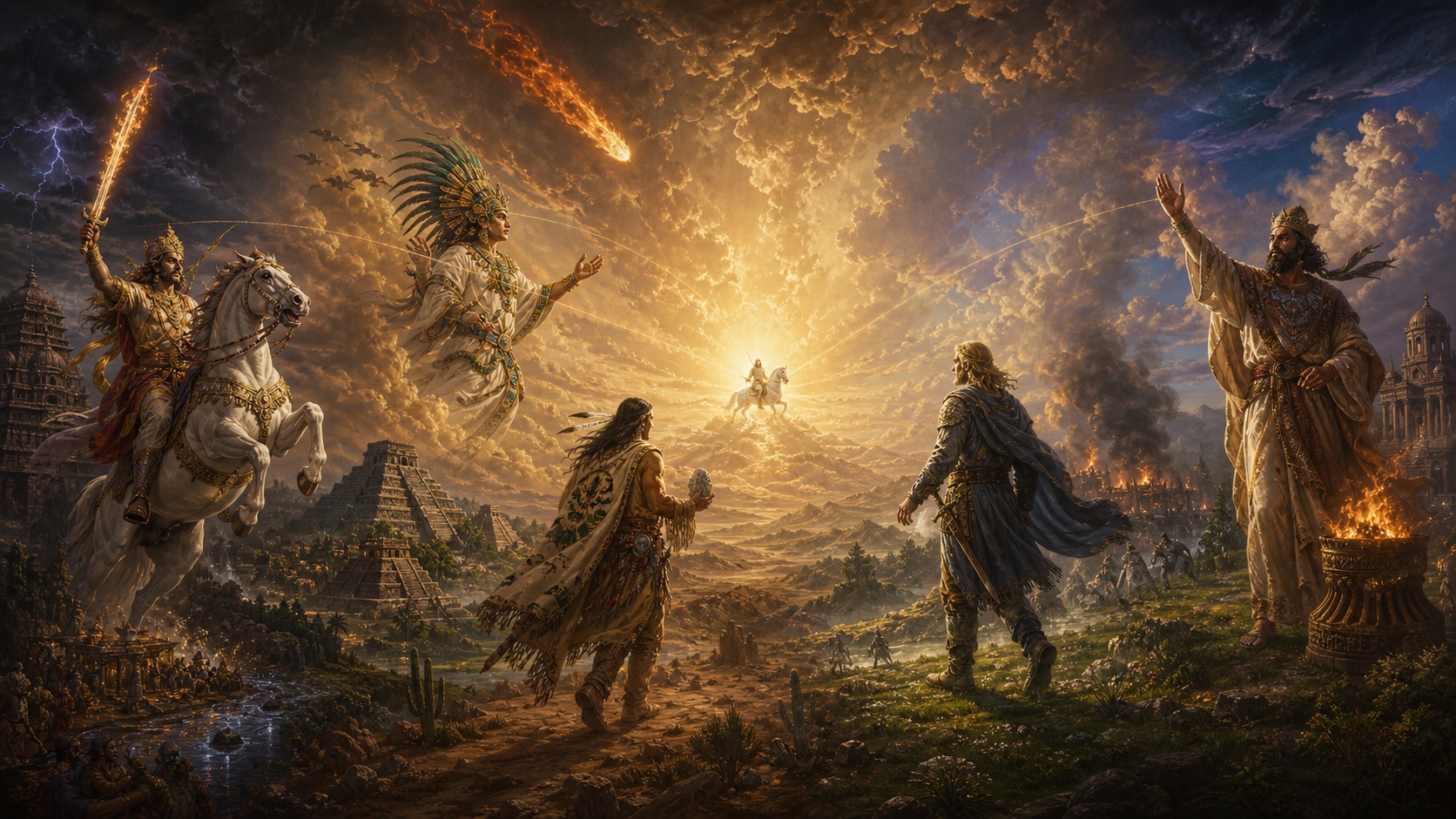
The thread runs both ways. Backward to Eden, forward to a single horizon. Every tradition saw both ends, but only one tradition kept them tied to the same God.
If you come from a Hindu background, the Mahabharata isn't wrong, it preserves something real. The Devas, the Pandavas, the cosmic war, the flood of Manu, these are memories of actual events, carried east from Babel by your ancestors, retold in Sanskrit instead of Hebrew, shaped by millennia of oral tradition into the forms you know.
If you come from a secular background, the archaeological evidence doesn't support a clean story of gradual progress. The oldest monuments are the most inexplicable. The engineering declines after the earliest dynasties. Over 200 civilizations remember a global flood with structural details too specific to be coincidence. Something happened.
If you come from any background at all, the question isn't whether the ancient world experienced these events. Every culture on earth says it did. The question is: which tradition preserved the original signal?
Which one names the God behind the judgment?
Which one explains why the divine beings fell?
Which one traces a single bloodline through the flood, through the dispersion, through the wars, through the centuries, all the way to a specific promise of redemption?
Which one has never lost the thread?
That's the Bible's claim. And the roots run deeper than you think.
The Question